
Introduction
PT-141 is a synthetic cyclic heptapeptide that occupies a distinctive niche within the broader melanocortin research-peptide family. The molecule was developed at Palatin Technologies in the late 1990s and early 2000s as part of a structured program to characterize melanocortin-receptor pharmacology, and it descends from a research lineage that traces back through Melanotan-II and ultimately to the natural pituitary hormone alpha-melanocyte-stimulating hormone (alpha-MSH). PT-141 retains the core melanocortin pharmacophore but was engineered to remove the lysine residue at position 10 of Melanotan-II, producing a related but distinguishable analog with a different receptor-selectivity profile.
The pharmacological story behind PT-141 is unusual and well-documented in the medicinal-chemistry literature. The compound was originally identified during early-stage clinical research on Melanotan-II in volunteer subjects, when investigators noticed that subjects in those studies reported a centrally mediated arousal response distinct from the pigmentary effects that were the main characterized endpoint at the time. That observation prompted a structured medicinal-chemistry program at Palatin to develop melanocortin analogs with selectivity for the central-arousal pathway, eventually identifying PT-141 as a lead compound for this research direction. The resulting molecule has been the subject of substantial academic and industry research on melanocortin-receptor signaling in central nervous system contexts.
This page is an educational reference for readers who want to understand what PT-141 actually is from a peptide-chemistry and pharmacology standpoint, where it came from in the broader melanocortin research lineage, what the published literature describes about its receptor-binding profile and its proposed mechanism, and where it sits in the broader melanocortin-research and central-nervous-system research landscapes. It is not a medical-use guide, does not describe any therapy or personal-application protocol, and makes no claims about effects in people who acquire the compound for research purposes. PT-141 supplied as a research peptide in this context is intended for laboratory and analytical work only.
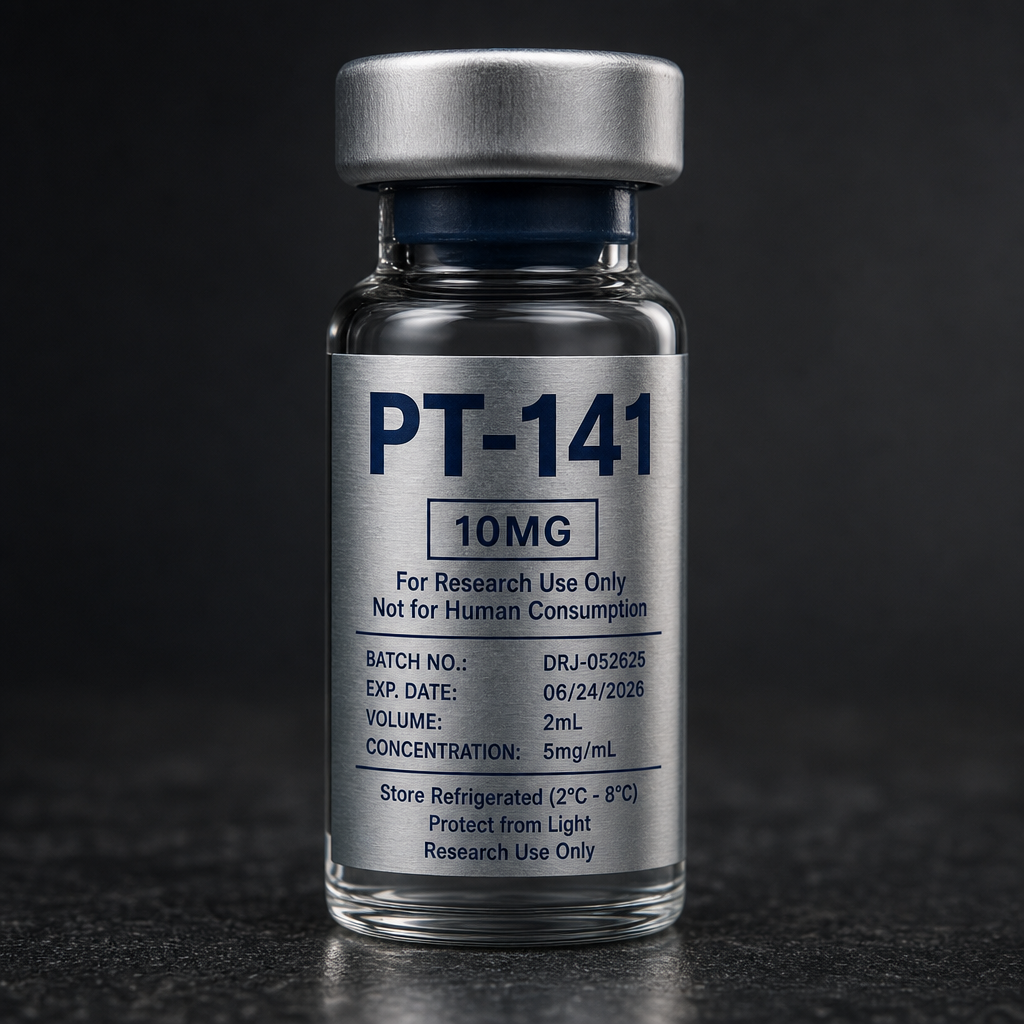
What Is DRJAYS PT-141™ 10MG?
PT-141 is a cyclic seven-amino-acid peptide built on a lactam-bridge scaffold that constrains the molecule's three-dimensional conformation around the core melanocortin pharmacophore. The sequence is Ac-Nle-cyclo(Asp-His-D-Phe-Arg-Trp-Lys)-OH, with the cyclization formed by an amide bond between the side-chain carboxylate of the aspartate residue and the side-chain amine of the lysine residue. The N-terminal residue is norleucine (Nle), a non-proteinogenic amino acid used as a metabolically stable analog of methionine. The acetyl group on the N-terminus provides additional stability against aminopeptidase degradation.
The pharmacophore at the core of PT-141 is the His-D-Phe-Arg-Trp tetrapeptide motif that mediates melanocortin-receptor binding across the broader melanocortin family. This motif is shared with alpha-MSH, with the synthetic analog Melanotan-II from which PT-141 is derived, and with many other melanocortin research peptides. The cyclic lactam constraint and the surrounding scaffold residues modulate the conformation in which the pharmacophore is presented to the melanocortin receptors, influencing the molecule's selectivity across the five known melanocortin receptor subtypes (MC1R through MC5R).
PT-141 binds the melanocortin receptors as an agonist, with its receptor-activity profile distinct from those of alpha-MSH and Melanotan-II. The relative potency at the various melanocortin receptor subtypes — particularly the relative activity at MC1R (associated with pigmentation responses) versus MC3R and MC4R (associated with central-nervous-system pathways including those involved in arousal and energy-balance regulation) — was a primary target of the Palatin medicinal-chemistry program. The literature characterization of PT-141 generally describes it as having a relative preference for MC3R and MC4R activation compared to its Melanotan-II parent, contributing to a different functional profile in research models.
It is worth being specific about what PT-141 is not. It is not a steroid or a sex hormone — it does not bind androgen, estrogen, or progesterone receptors. It is not a phosphodiesterase inhibitor and does not work through the cyclic-GMP / nitric-oxide vasodilation pathway used by some other arousal-research molecules. It does not bind dopamine, serotonin, or adrenergic receptors. It is a melanocortin-receptor peptide, with its effects mediated through the melanocortin signaling pathway and its downstream cellular cascades, distinct from the receptor systems that other arousal-related research compounds target.
History and Development
PT-141's development sits inside the broader history of melanocortin pharmacology that has unfolded across roughly seven decades of research.
The natural hormone alpha-MSH was first isolated and characterized in the 1950s as a 13-amino-acid pituitary peptide cleaved from the precursor protein pro-opiomelanocortin (POMC). The role of alpha-MSH in pigmentation regulation through melanocortin-1-receptor signaling on melanocytes was established through subsequent decades of work. The five melanocortin receptor subtypes (MC1R through MC5R) were cloned and characterized in the early 1990s by several laboratories, with the realization that the melanocortin system extends well beyond pigmentation into central nervous system pathways and peripheral tissue functions including immune modulation, energy balance, and steroidogenesis.
The Melanotan research program at the University of Arizona, led principally by Mac Hadley and Victor Hruby in the 1980s, produced the synthetic alpha-MSH analogs Melanotan-I (afamelanotide) and Melanotan-II. These compounds were designed for research on melanocortin pharmacology and on potential pigmentation-related applications. During early-stage clinical research on Melanotan-II in volunteer subjects, investigators observed a centrally mediated arousal response that had not been the primary endpoint of those studies, prompting interest in a melanocortin-based approach to central nervous system arousal pharmacology.
Palatin Technologies, a New Jersey-based pharmaceutical company, undertook a structured medicinal-chemistry program in the late 1990s to develop melanocortin analogs with selectivity for the central-arousal pathway. The program identified PT-141 as a lead compound and pursued its development through preclinical and clinical research over the subsequent two decades. The compound was eventually approved by the U.S. Food and Drug Administration in 2019 under the brand name Vyleesi for a specific clinical indication in adult female patients. The compound is also available outside that approved-product channel in research-peptide supply for laboratory work.
The broader melanocortin research field has continued to expand through the 2000s, 2010s, and into the 2020s, with substantial work on MC4R as a drug-discovery target for energy-balance and weight-related research (resulting in the approved compound setmelanotide for specific genetic obesity conditions), on MC1R as a pigmentation and DNA-damage-response research target, and on the broader melanocortin signaling pathway as a node in many tissue-biology and disease-research contexts.
Important milestones include the 1950s isolation of alpha-MSH, the early-1990s cloning of the five melanocortin receptor subtypes, the 1980s University of Arizona Melanotan-I and Melanotan-II development, the late-1990s and 2000s Palatin Technologies PT-141 development program, and the 2019 regulatory approval of the compound under the Vyleesi brand for a specific clinical indication.
Understanding the Science
The science of PT-141 is anchored in three connected areas: the melanocortin receptor family and the alpha-MSH signaling system, the cyclic-peptide medicinal chemistry that produced the PT-141 scaffold from the broader Melanotan lineage, and the central-nervous-system neurobiology of melanocortin signaling in arousal-related pathways.
The melanocortin receptor family
The melanocortin receptors are a family of five G-protein-coupled receptors (MC1R through MC5R) that all couple primarily through Gs to activate adenylyl cyclase and increase intracellular cyclic AMP. The receptors differ in their tissue distribution, in their selectivity for the various endogenous melanocortin ligands (alpha-MSH, beta-MSH, gamma-MSH, and ACTH), and in their physiological roles. MC1R is expressed prominently on melanocytes and mediates pigmentation responses to alpha-MSH; MC2R is the ACTH receptor on adrenocortical cells; MC3R and MC4R are expressed prominently in the central nervous system and mediate energy-balance and arousal-related signaling; MC5R is expressed in many peripheral tissues with a less well-characterized integrated role. PT-141 is an agonist across the melanocortin family with a relative-preference profile favoring MC3R and MC4R compared to its Melanotan-II parent.
Cyclic-peptide scaffold
PT-141's cyclic lactam-bridge scaffold is a representative example of constrained-peptide medicinal chemistry. The cyclization between the aspartate side chain and the lysine side chain locks the molecule's three-dimensional shape around the core His-D-Phe-Arg-Trp pharmacophore, restricting the conformations the peptide can adopt and modulating the way the pharmacophore is presented to the melanocortin receptors. The D-phenylalanine substitution at the position 7 of the parent sequence is another deliberate design choice: replacing the natural L-phenylalanine with its D-enantiomer increases metabolic stability against proteolysis and modulates receptor-binding kinetics. The N-terminal norleucine and N-terminal acetyl group similarly contribute to metabolic stability.
Central melanocortin signaling in arousal
Central nervous system melanocortin signaling, particularly through MC4R expressed in hypothalamic and other limbic-system regions, has been characterized in research on arousal-related neurobiology. The published mechanism literature for PT-141 in this domain centers on activation of MC4R-expressing neuronal populations in specific hypothalamic regions and on the downstream signaling cascades that propagate from those activated neurons through the broader central-nervous-system circuitry. The compound's penetration of the blood-brain barrier (assisted by the cyclic-peptide scaffold and the constrained conformation) allows central receptor engagement after systemic administration in research-model contexts.
Receptor signaling downstream of melanocortin binding
Downstream of melanocortin-receptor activation, the canonical pathway proceeds through Gs-mediated stimulation of adenylyl cyclase, elevation of intracellular cyclic AMP, activation of protein kinase A, and phosphorylation of multiple downstream substrates including transcription factors (such as CREB) that regulate gene expression in the responding cell. Additional signaling through ERK / MAPK pathways and through other secondary pathways is characterized in some melanocortin-receptor research contexts. The integrated downstream signaling depends on the receptor subtype activated, on the cellular context, and on the duration and magnitude of the receptor activation produced by the agonist.
Selectivity profile and off-target receptors
PT-141's selectivity within the melanocortin family is a relative-preference profile rather than absolute selectivity. The compound activates multiple melanocortin receptors at the concentrations relevant in research and clinical contexts, with the relative activity across MC1R, MC3R, MC4R, and MC5R contributing to the overall functional profile. Outside the melanocortin family, the compound's receptor profile is generally characterized as clean, with no significant binding to the major receptor families (dopamine, serotonin, adrenergic, opioid, GABA, glutamate) that would suggest off-target neuropharmacology.
- PT-141 is a cyclic seven-amino-acid melanocortin research peptide built on a lactam-bridge scaffold around the core His-D-Phe-Arg-Trp pharmacophore.
- Developed at Palatin Technologies as a melanocortin analog with a relative-preference profile favoring MC3R and MC4R compared to its Melanotan-II parent.
- Descends from the broader alpha-MSH and Melanotan research lineage developed principally at the University of Arizona in the 1980s.
- Approved by the U.S. FDA in 2019 under the brand name Vyleesi for a specific clinical indication in adult female patients.
- Acts as a melanocortin-receptor agonist signaling through Gs / cyclic AMP / PKA cascades; distinct from steroid, PDE-inhibitor, or monoamine-receptor mechanisms.
Structural Characteristics
Structurally, PT-141 is a cyclic heptapeptide with the sequence Ac-Nle-cyclo(Asp-His-D-Phe-Arg-Trp-Lys)-OH and a molecular mass of approximately 1025 daltons in the free-base form. The cyclization is formed by an amide bond between the side-chain carboxylate of the aspartate residue and the side-chain amine of the lysine residue, producing a constrained ring that locks the molecule's three-dimensional conformation around the core melanocortin pharmacophore.
The amino acid composition includes several non-standard features that distinguish PT-141 from a simple natural-sequence analog. The N-terminal norleucine (Nle) is a non-proteinogenic amino acid used as a metabolically stable analog of methionine — it has the same backbone chemistry as methionine but lacks the oxidation-sensitive sulfur-containing side chain. The N-terminal acetyl group caps the free alpha-amine and prevents aminopeptidase degradation. The D-phenylalanine at position 4 of the cyclic sequence replaces the natural L-phenylalanine, providing increased metabolic stability and modulated receptor-binding kinetics.
The cyclic lactam-bridge constraint is the defining structural feature relative to a linear analog. The constraint locks the molecule into a conformation that pre-organizes the pharmacophore for melanocortin-receptor binding, reducing the entropic cost of binding and modulating selectivity across the receptor subtypes. This kind of cyclic-peptide constraint is a representative example of the broader medicinal-chemistry strategy of constraining peptide conformation through cyclization, disulfide bridges, lactam bridges, or other covalent constraints.
The combined structural design — cyclic constraint, N-terminal capping, D-amino-acid substitution, non-proteinogenic norleucine — gives PT-141 substantially better metabolic stability than the parent alpha-MSH or a linear unmodified analog, allowing meaningful systemic exposure after subcutaneous administration in research and clinical contexts. The cyclic structure also contributes to the compound's ability to cross the blood-brain barrier and access central melanocortin receptors that underlie the molecule's central-nervous-system effects.
Areas of Scientific Interest
PT-141 is studied in laboratory contexts that span melanocortin-receptor pharmacology, central-nervous-system arousal-related neurobiology, and broader cyclic-peptide medicinal chemistry.
In melanocortin-receptor pharmacology, PT-141 serves as a reference research compound for studies on the relative-activity profile across MC1R through MC5R, on the downstream signaling cascades activated by melanocortin-receptor engagement, on the structure-activity relationships within the broader cyclic-melanocortin scaffold family, and on the receptor-binding kinetics and thermodynamics characterized through binding-assay and signaling-assay methodologies. The compound's well-defined receptor-activity profile makes it useful as a reference comparator alongside alpha-MSH, Melanotan-II, setmelanotide, and other melanocortin research peptides.
In central-nervous-system neurobiology, PT-141 appears in studies on melanocortin signaling in hypothalamic and limbic-system circuits, on the central neural pathways activated by MC4R engagement, on the downstream propagation of melanocortin signals through broader CNS circuitry, and on the functional integration of melanocortin signaling with other neuromodulatory systems. The compound's blood-brain-barrier penetration after systemic administration allows central engagement that would not be possible with a non-penetrant analog, supporting research on the central effects of melanocortin pharmacology.
In broader cyclic-peptide medicinal chemistry, PT-141's scaffold is a representative example of constrained-peptide design and is studied in methodology-research contexts on cyclization strategies, on conformational analysis by NMR and computational methods, on receptor-binding optimization through scaffold modification, and on the broader principles of constrained-peptide drug design. The compound is sometimes used in teaching and training contexts as a worked example of how a complex constrained-peptide drug was developed from a parent natural-sequence lineage.
In analytical and product-characterization research, PT-141 serves as a reference cyclic-melanocortin peptide for studies on analytical methodology (HPLC, mass spectrometry, NMR), on stability characterization across various storage and formulation conditions, on impurity profiling and synthesis optimization, and on regulatory-compliance characterization for the approved-product channel.
Across all of these contexts, the research applications in the research-peptide supply context are laboratory and analytical in nature. The compound's status as an approved pharmaceutical for a specific clinical indication under the Vyleesi brand is a separate channel; research-peptide use is intended for laboratory and analytical work distinct from clinical use of the approved product.
Comparison With Related Compounds
PT-141 sits within the broader landscape of melanocortin research peptides, with related but distinguishable comparators across the cyclic-melanocortin, linear-MSH, and selective-MC4R agonist categories.
| Compound | Classification | Distinguishing feature |
|---|---|---|
| Alpha-MSH | Natural 13-amino-acid pituitary melanocortin hormone | Parent natural-sequence reference; non-selective across melanocortin receptors; rapidly degraded in plasma; the starting point for the synthetic-analog research lineage that produced PT-141. |
| Melanotan-II | Cyclic seven-amino-acid melanocortin research peptide | Closely related parent compound from the University of Arizona research program; differs from PT-141 in the C-terminal residue and has a different relative-selectivity profile across the melanocortin receptors. |
| Melanotan-I (afamelanotide) | Linear 13-amino-acid alpha-MSH analog | Different scaffold — linear rather than cyclic — and different functional profile; approved for a specific pigmentation-related clinical indication; sits in the same broader melanocortin research lineage. |
| Setmelanotide | Cyclic selective MC4R agonist | Selective for MC4R rather than non-selective across the melanocortin family; developed for genetic-obesity research and approved for specific clinical indications; addresses the energy-balance side of MC4R biology rather than the arousal-related side. |
| ACTH | Natural 39-amino-acid melanocortin hormone | Selective for MC2R on adrenocortical cells; functionally distinct from PT-141; included for completeness of the broader melanocortin-family context. |
Frequently Asked Questions
Q.What is PT-141?
PT-141 is a synthetic cyclic seven-amino-acid melanocortin research peptide developed at Palatin Technologies in the late 1990s and early 2000s. It descends from the broader alpha-MSH and Melanotan research lineage and was engineered to have a relative-preference profile favoring MC3R and MC4R within the melanocortin receptor family. The compound is also marketed under the brand name Vyleesi for a specific clinical indication approved by the U.S. FDA in 2019; the research-peptide supply for laboratory work is a separate channel.
Q.How does PT-141 work?
PT-141 is a melanocortin-receptor agonist. It binds and activates the five melanocortin receptors (MC1R through MC5R) with a relative-preference profile favoring MC3R and MC4R. Downstream signaling proceeds through Gs-coupled adenylyl-cyclase activation, elevation of intracellular cyclic AMP, activation of protein kinase A, and phosphorylation of downstream substrates including transcription factors. In central-nervous-system contexts, MC4R engagement on hypothalamic neuronal populations is characterized as central to the compound's arousal-related effects in research models.
Q.What is the difference between PT-141 and Melanotan-II?
PT-141 is structurally derived from Melanotan-II but lacks the C-terminal lysine residue of the Melanotan-II sequence. The two compounds share the core cyclic-melanocortin scaffold and the central His-D-Phe-Arg-Trp pharmacophore but differ in their relative-selectivity profiles across the melanocortin receptor subtypes. PT-141 was engineered specifically to have a relative-preference profile favoring MC3R and MC4R, whereas Melanotan-II retains substantial activity at MC1R that underlies its pigmentation-related effects in research models.
Q.Is PT-141 a hormone?
PT-141 is a synthetic peptide modeled on the natural hormone alpha-MSH, which is a peptide hormone secreted by the pituitary. PT-141 itself is not a hormone in the strict endocrinological sense — it is a synthetic analog used in research and clinical contexts. But it acts through the same melanocortin receptor family that responds to the natural alpha-MSH and other endogenous melanocortin peptides, so its pharmacology is melanocortin-system pharmacology.
Q.What are the melanocortin receptors?
The melanocortin receptors are a family of five G-protein-coupled receptors (MC1R through MC5R) that all couple primarily through Gs to activate adenylyl cyclase and elevate cyclic AMP. They respond to the endogenous melanocortin peptides alpha-MSH, beta-MSH, gamma-MSH, and ACTH. MC1R is on melanocytes and mediates pigmentation responses; MC2R is the ACTH receptor on adrenocortical cells; MC3R and MC4R are prominent in the central nervous system and mediate energy-balance and arousal-related signaling; MC5R is in many peripheral tissues with a less well-characterized integrated role.
Q.Who developed PT-141?
PT-141 was developed at Palatin Technologies, a pharmaceutical company based in New Jersey, USA, through a structured medicinal-chemistry program in the late 1990s and early 2000s. The program built on observations from earlier-stage research on Melanotan-II conducted by the University of Arizona group and worked through preclinical and clinical development over the subsequent two decades, eventually resulting in regulatory approval of the compound under the brand name Vyleesi in 2019.
Q.What does the 'cyclic' part of the structure do?
The cyclic lactam-bridge constraint locks the peptide's three-dimensional shape around the core melanocortin pharmacophore. By restricting the conformations the peptide can adopt, the constraint pre-organizes the molecule for melanocortin-receptor binding, reducing the entropic cost of binding and modulating selectivity across the receptor subtypes. The cyclic constraint also contributes to metabolic stability against the proteases that would otherwise rapidly degrade a linear peptide and contributes to the compound's blood-brain-barrier penetration after systemic administration.
Q.Does PT-141 cross the blood-brain barrier?
Yes — research and clinical characterization of PT-141 supports meaningful central engagement after systemic administration, consistent with blood-brain-barrier penetration. The cyclic-peptide scaffold, the constrained conformation, the N-terminal acetylation, the D-amino-acid substitution, and the non-proteinogenic norleucine residue all contribute to the combination of metabolic stability and physicochemical properties that allow central exposure. The central engagement is central to the compound's arousal-related effects, which are mediated through MC4R signaling in hypothalamic and limbic-system circuits.
Q.Is PT-141 a steroid or sex hormone?
No. PT-141 is not a steroid and does not bind androgen, estrogen, or progesterone receptors. It is also not a phosphodiesterase inhibitor and does not work through the cyclic-GMP / nitric-oxide vasodilation pathway used by some other arousal-related research compounds. PT-141 acts entirely through the melanocortin receptor family and the Gs / cyclic AMP / PKA signaling cascade downstream of those receptors, with the functional effects mediated through central melanocortin signaling rather than through hormone-receptor or vasodilation pathways.
Q.How is PT-141 administered in research contexts?
In published research and clinical literature, PT-141 is generally administered by subcutaneous injection. The cyclic-peptide structure is not orally bioavailable in any practical way — like most peptides, the molecule would be degraded in the gastrointestinal tract before significant absorption. Subcutaneous administration of the reconstituted lyophilized compound is the standard research and clinical route. The research-peptide supply context contemplates laboratory and analytical work rather than personal administration; the approved-product channel under the Vyleesi brand involves administration under clinical supervision for the approved indication.
Q.What is the molecular weight of PT-141?
PT-141 has a molecular mass of approximately 1025 daltons in the free-base form. The cyclic heptapeptide with the N-terminal acetylated norleucine, the D-phenylalanine substitution, and the lactam-bridge cyclization between the aspartate and lysine residues gives the characteristic mass. The exact mass for a particular batch is reported on the Certificate of Analysis from a reputable research-peptide supplier and confirmed by mass spectrometry.
Q.How is PT-141 manufactured?
Research-grade PT-141 is produced by solid-phase peptide synthesis using Fmoc protecting-group chemistry, with the linear precursor assembled on a suitable resin and the lactam-bridge cyclization formed either on-resin or in solution after cleavage. The cyclization step is a key synthesis-design choice and is generally performed under conditions that favor the intramolecular reaction over intermolecular side reactions. The crude cyclic peptide is purified by reversed-phase HPLC and characterized by mass spectrometry, NMR, and other analytical methods. Reputable suppliers report purity in the 98-99% range for research-grade material.
Q.Is PT-141 approved as a medicine?
PT-141 was approved by the U.S. FDA in 2019 under the brand name Vyleesi for a specific clinical indication in adult female patients. That regulatory approval is the channel through which the compound is used as an approved medicine in the United States. The research-peptide supply of PT-141 for laboratory and analytical work is a separate channel from the approved-product channel; the research-peptide use is intended for laboratory work, not personal administration or clinical use.
Q.What storage and reconstitution practices apply?
Lyophilized PT-141 stored sealed at -20 °C or below away from light is generally considered stable for extended periods. The cyclic-peptide scaffold provides good chemical stability relative to linear peptides. After reconstitution in sterile water or bacteriostatic water, the compound is typically stored refrigerated and used within several weeks; the constrained cyclic structure makes the reconstituted material more stable than many linear peptides of similar size. Standard research-laboratory storage and handling practices apply.
Q.How does PT-141 compare to alpha-MSH?
Alpha-MSH is the natural 13-amino-acid pituitary hormone from which the melanocortin synthetic-analog lineage descends. It binds all five melanocortin receptors with limited selectivity and is rapidly degraded by plasma proteases, giving it very limited duration of action after systemic administration. PT-141 is a synthetic seven-amino-acid cyclic analog with substantially better metabolic stability and a different relative-selectivity profile across the receptor subtypes. The two compounds share the core melanocortin pharmacophore and pharmacology but differ in their stability, selectivity, and practical research-use profiles.
Q.What is MC4R?
MC4R is the melanocortin-4 receptor, a G-protein-coupled receptor expressed prominently in the central nervous system, particularly in hypothalamic and limbic-system regions. MC4R signaling is involved in energy-balance regulation (which made it a drug-discovery target for setmelanotide for specific genetic-obesity conditions) and in central arousal-related pathways. PT-141's MC4R agonist activity is generally characterized as central to its central-nervous-system effects in research and clinical contexts.
Q.What is Vyleesi?
Vyleesi is the brand name under which PT-141 is approved by the U.S. FDA for a specific clinical indication in adult female patients, approved in 2019. The approved-product channel involves the compound formulated for subcutaneous administration via a specific delivery device, used under clinical supervision for the approved indication. The research-peptide supply of the same molecule for laboratory work is a separate channel from the approved-product channel.
Q.Is PT-141 safe?
Comprehensive safety characterization of PT-141 was conducted as part of the regulatory-approval process for the Vyleesi product, and the approved-product label includes the documented safety profile for that indication and use context. The research-peptide supply of the compound for laboratory work is a separate channel; the comprehensive safety characterization is applicable to clinical use of the approved product rather than to laboratory research use. Educational discussion of safety should remain within the laboratory-research and approved-product framings appropriate to the actual use channels rather than extrapolating to off-label or personal-use contexts.
Glossary of Terms
- PT-141
- Synthetic cyclic seven-amino-acid melanocortin research peptide developed at Palatin Technologies; also marketed under the brand name Vyleesi for a specific clinical indication.
- Melanocortin receptors
- Family of five G-protein-coupled receptors (MC1R through MC5R) that respond to alpha-MSH and other endogenous melanocortin peptides; PT-141 is an agonist across the family with a relative preference for MC3R and MC4R.
- Alpha-MSH
- Natural 13-amino-acid pituitary melanocortin hormone; the starting point of the synthetic-analog research lineage that produced PT-141.
- Melanotan-II
- Cyclic seven-amino-acid melanocortin research peptide from the University of Arizona research program; the direct parent compound from which PT-141 was derived.
- Cyclic lactam bridge
- Amide-bond cyclization between a side-chain carboxylate and a side-chain amine; the structural feature that locks PT-141's conformation around the core melanocortin pharmacophore.
- His-D-Phe-Arg-Trp
- Core pharmacophore motif shared across the melanocortin agonist family; the central sequence that mediates melanocortin-receptor binding.
- Norleucine (Nle)
- Non-proteinogenic amino acid used as a metabolically stable analog of methionine; the N-terminal residue of PT-141.
- Palatin Technologies
- New Jersey-based pharmaceutical company that developed PT-141 through a structured medicinal-chemistry program in the late 1990s and 2000s.
- Vyleesi
- Brand name under which PT-141 is approved by the U.S. FDA for a specific clinical indication in adult female patients, approved in 2019.
- MC4R
- Melanocortin-4 receptor; G-protein-coupled receptor expressed prominently in the central nervous system and central to PT-141's central effects in research models.
Summary
PT-141 is a synthetic cyclic seven-amino-acid melanocortin research peptide developed at Palatin Technologies in the late 1990s and early 2000s, descended from the broader alpha-MSH and Melanotan research lineage developed principally at the University of Arizona in the 1980s. The molecule is built on a cyclic lactam-bridge scaffold around the core His-D-Phe-Arg-Trp melanocortin pharmacophore, with the cyclization, the N-terminal acetylated norleucine, and the D-phenylalanine substitution combining to give the compound good metabolic stability and a relative-selectivity profile favoring MC3R and MC4R within the melanocortin receptor family.
The mechanism is melanocortin-receptor agonism with downstream Gs / cyclic AMP / protein kinase A signaling, and the central-nervous-system effects studied in research and clinical contexts are mediated principally through MC4R activation on hypothalamic and limbic-system neuronal populations. The compound's blood-brain-barrier penetration after systemic administration allows the central engagement that distinguishes its functional profile from melanocortin agonists that do not penetrate the CNS.
PT-141 was approved by the U.S. FDA in 2019 under the brand name Vyleesi for a specific clinical indication in adult female patients, with the approved-product channel separate from the research-peptide supply channel for laboratory work. The published research footprint of the compound spans melanocortin-receptor pharmacology, central-nervous-system arousal-related neurobiology, cyclic-peptide medicinal chemistry, and analytical characterization. The molecule appears in many research contexts as a reference cyclic-melanocortin agonist with a well-characterized receptor-activity profile.
For students, researchers, and curious readers approaching PT-141 for the first time, the most accurate framing is of a thoughtfully engineered cyclic melanocortin research peptide with a well-documented developmental history, a clear receptor-pharmacology profile within the melanocortin signaling system, and a defined place in both the approved-product clinical channel and the broader research-peptide and melanocortin-pharmacology research landscapes.
Scientific References
Selected peer-reviewed and primary-source citations used to inform this educational overview. Inclusion does not imply endorsement of any non-research use of DRJAYS PT-141™ 10MG.
- Diamond, L. E., et al. (2004). An effect on the subjective sexual response in premenopausal women with sexual arousal disorder by PT-141, a melanocortin receptor agonist. Journal of Sexual Medicine, 3(4), 628-638.Representative early-stage clinical-research characterization of PT-141 in the arousal-research context.
- Hadley, M. E., & Dorr, R. T. (2006). Melanocortin peptide therapeutics: historical milestones, clinical studies and commercialization. Peptides, 27(4), 921-930.Historical and pharmacological review of the broader melanocortin research lineage that produced PT-141.
- Pfaus, J., et al. (2007). Selective facilitation of sexual solicitation in the female rat by a melanocortin receptor agonist. PNAS, 101(27), 10201-10204.Representative preclinical characterization of PT-141 in central melanocortin signaling and arousal research.
- King, S. H., et al. (2007). Melanocortin receptors, melanotropic peptides and penile erection. Current Topics in Medicinal Chemistry, 7(11), 1098-1106.Mechanism-focused review of melanocortin signaling in central nervous system pathways relevant to PT-141 research.