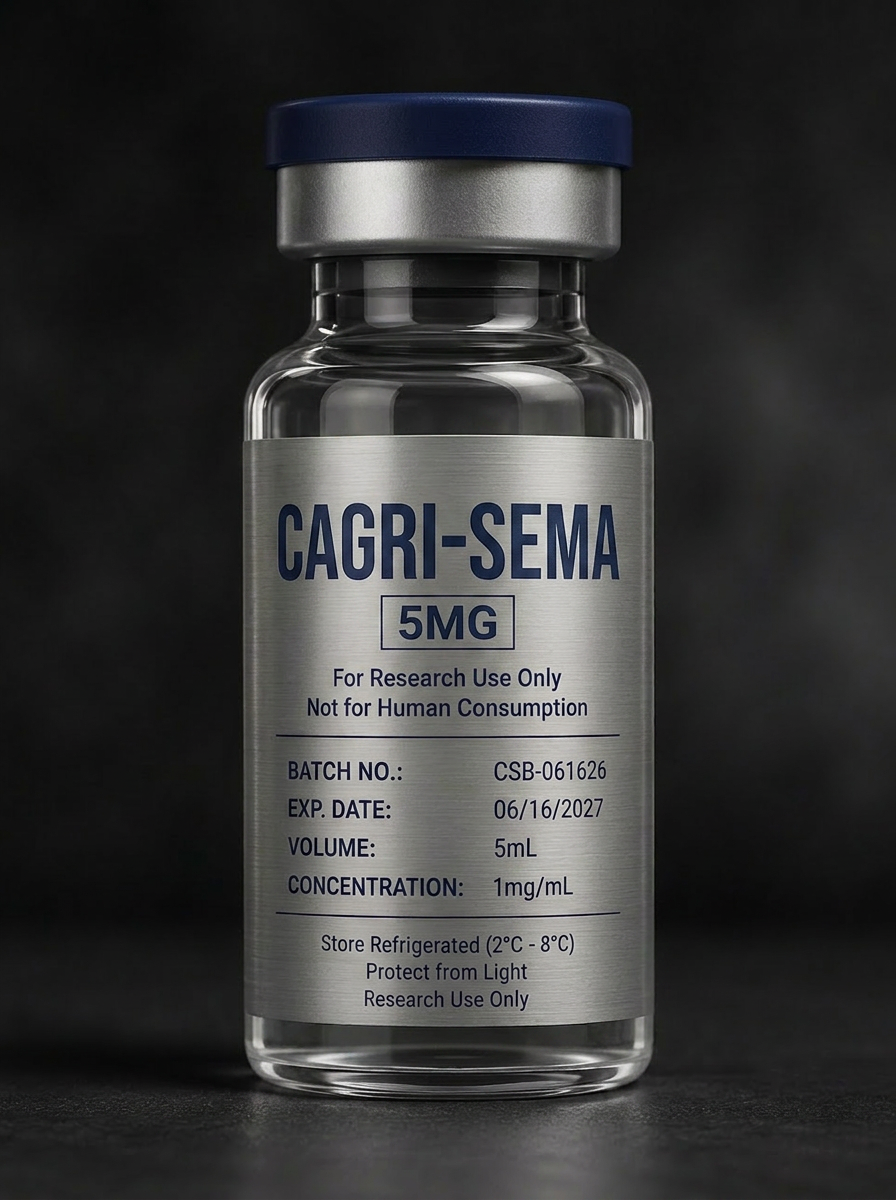
Cagri-Sema is studied in laboratory contexts that span multi-receptor combination pharmacology, amylin and GLP-1 receptor signaling integration, satiety-signaling and energy-balance research, and broader long-acting peptide combination engineering.
In multi-receptor combination pharmacology, Cagri-Sema serves as a representative example of complementary combination engagement of two distinct receptor systems. The combination is used in research on the principles of complementary receptor engagement, on the pharmacological characterization of integrated effect profiles relative to component effects, on the comparative pharmacology of combination dosing versus single-compound dosing, and on the broader principles of multi-receptor combination strategies in peptide pharmacology.
In amylin and GLP-1 receptor signaling integration research, Cagri-Sema is studied in research on the integrated downstream signaling at the cellular and tissue level when both receptor systems are engaged simultaneously, on the integration of satiety signaling from the two systems at central nervous system sites, on the integration of gastrointestinal effects from the two systems at the gut level, and on the integration of pancreatic effects (insulin, glucagon, beta-cell function) at the islet level.
In satiety-signaling and energy-balance research, Cagri-Sema appears in research on the chronic effects of sustained engagement of both signaling systems on energy-balance endpoints, on the pharmacology of satiety-related signaling in central nervous system contexts, and on the integration of metabolic signaling in chronic-dosing research contexts.
In broader long-acting peptide combination engineering research, Cagri-Sema serves as a worked example of how two long-acting peptides with pharmacokinetically compatible profiles can be combined in a single research-peptide vial for research on combination pharmacology. The combination is used in methodology-research contexts on combination-peptide formulation, on stability characterization of combination preparations, on analytical methodology for combination-peptide characterization (HPLC and mass spectrometry of combination preparations), and on the broader principles of combination-peptide research.
Across all of these contexts, the research applications in the research-peptide supply context are laboratory and analytical in nature. The compound's status as an investigational combination in clinical research is a separate channel from the research-peptide supply for laboratory work.