
Introduction
Cagrilintide is a long-acting synthetic amylin analog developed by Novo Nordisk and characterized in a substantial body of preclinical and clinical research over the past decade. The compound is a thoughtfully engineered modification of the natural pancreatic hormone amylin, designed with a fatty-acid side chain that enables once-weekly dosing in research and clinical contexts. Cagrilintide occupies a distinctive position within the broader satiety and metabolic research landscape: it is structurally and mechanistically related to the long-established research peptide pramlintide (a soluble amylin analog approved for clinical use in 2005) but differs in its long-acting profile and in some of its receptor-engagement characteristics.
The conceptual story behind cagrilintide is the convergence of three threads of research. First is the amylin biology that emerged through the 1980s and 1990s, beginning with the identification of amylin as a 37-amino-acid peptide co-secreted with insulin from pancreatic beta cells and its characterization as a satiety-signaling and gastric-emptying-regulating hormone. Second is the calcitonin-receptor pharmacology that emerged through the same period, with the recognition that amylin acts through receptors built from the calcitonin receptor in combination with receptor-activity-modifying proteins (RAMPs). Third is the long-acting peptide engineering technology developed at Novo Nordisk through the 2000s and 2010s, primarily through the lipidation strategies that produced the long-acting GLP-1 analogs liraglutide and semaglutide.
This page is an educational reference for readers who want to understand what cagrilintide actually is from a peptide-chemistry and pharmacology standpoint, where it came from in the broader amylin-and-calcitonin-receptor research lineage, what the published literature describes about its mechanism and effects, and where it sits in the broader metabolic-research and satiety-signaling research landscapes. It is not a medical-use guide, does not describe any therapy or personal-application protocol, and makes no claims about effects in people who acquire the compound for research purposes. Cagrilintide supplied as a research peptide in this context is intended for laboratory and analytical work only.
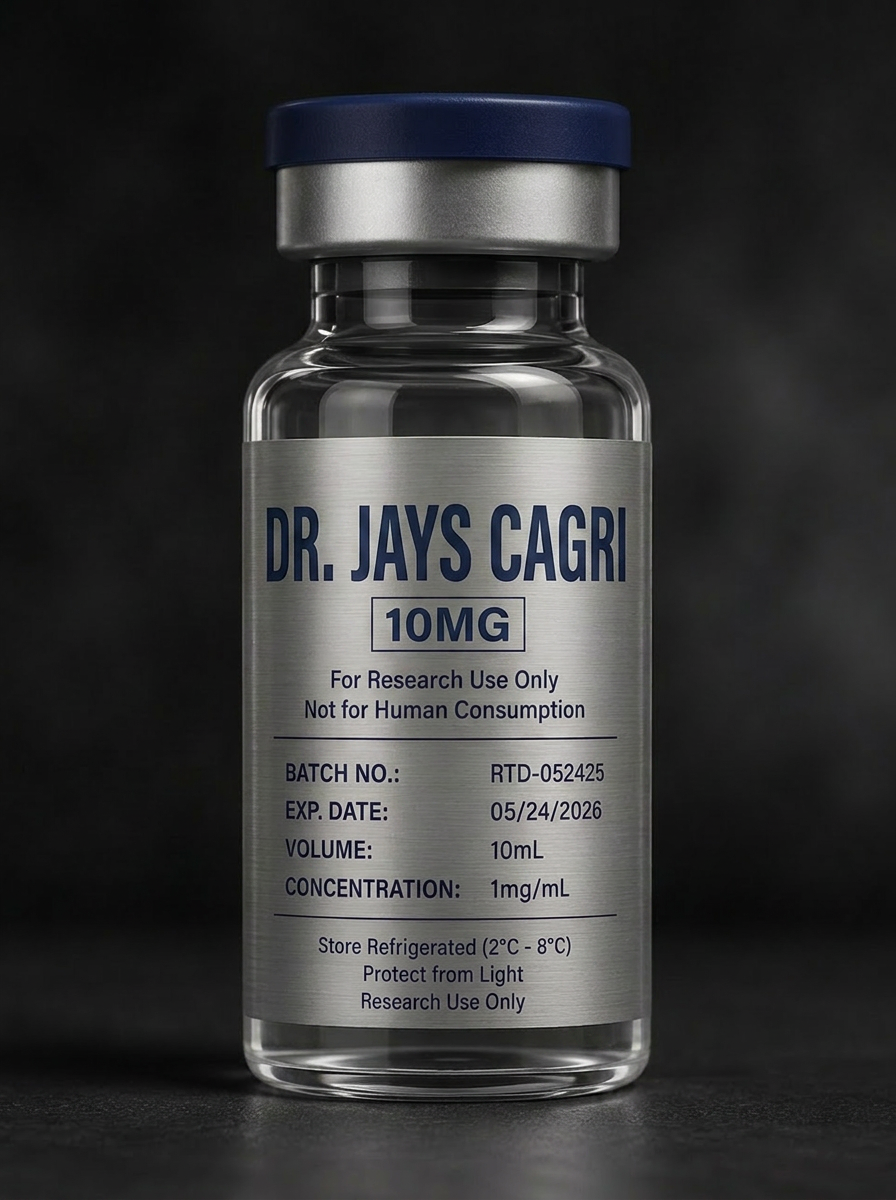
What Is Dr. Jays Cagri 10MG (Cagrilintide)?
Cagrilintide is a synthetic linear peptide with the same 37-amino-acid backbone as natural human amylin and pramlintide, but with several specific amino-acid substitutions and a fatty-acid side chain conjugated through a glutamic-acid spacer at one of the lysine residues. The molecule retains the disulfide-bridged N-terminal loop (formed between cysteines at positions 2 and 7) that is critical for amylin/calcitonin-receptor engagement, and it retains the C-terminal amidation that is also critical for receptor binding.
The natural human amylin sequence has a serious chemical-stability liability: it has three consecutive amino acids in the central region of the peptide that promote beta-sheet self-aggregation and amyloid-fibril formation, making the natural sequence essentially impractical as a pharmaceutical because it would precipitate out of solution. Pramlintide addresses this liability by substituting proline residues at three positions (25, 28, and 29) in place of the aggregation-promoting native residues; the substitutions are based on the corresponding residues in rat amylin, which does not exhibit the aggregation behavior. Cagrilintide inherits the pramlintide-style proline substitutions and adds further modifications.
The lipidation strategy is the defining structural innovation of cagrilintide. A fatty-acid side chain (typically a C18 di-acid, similar to the design used in semaglutide) is attached to a lysine residue through a glutamic-acid spacer using the same general design principles that produced the long-acting GLP-1 analogs at Novo Nordisk. The fatty-acid side chain binds reversibly and with high affinity to circulating serum albumin after subcutaneous administration, creating a depot of albumin-bound peptide that releases free peptide gradually into circulation. This albumin-binding strategy extends the elimination half-life of the peptide from the hours-to-day range typical of unmodified pramlintide to the multi-day range that supports once-weekly dosing in research and clinical contexts.
The combined design — proline-substituted amylin scaffold, disulfide-bridged N-terminal loop, C-terminal amidation, fatty-acid lipidation through a glutamic-acid spacer — produces a long-acting amylin analog suitable for research on the chronic effects of sustained amylin/calcitonin-receptor agonism in metabolic-research contexts.
It is worth being specific about what cagrilintide is not. It is not a GLP-1 receptor agonist — it does not bind the GLP-1 receptor and does not share the incretin-mimetic pharmacology of semaglutide or liraglutide. It is not insulin and does not bind insulin receptors. It acts through the amylin/calcitonin-receptor family in combination with RAMPs, a distinct receptor system from the incretin receptors. Cagrilintide is often studied in combination with GLP-1 receptor agonists because the two pharmacologies are complementary, but the receptor systems and the molecular mechanisms are distinct.
History and Development
Cagrilintide's development sits at the convergence of amylin biology research, calcitonin-receptor pharmacology, and the long-acting peptide engineering technology developed at Novo Nordisk over the past three decades.
The amylin story begins in the late 1980s with the identification of amylin (also called islet amyloid polypeptide, IAPP) as the principal protein component of the amyloid deposits found in the pancreatic islets of patients with long-standing type 2 diabetes. Subsequent work characterized amylin as a 37-amino-acid peptide co-secreted with insulin from pancreatic beta cells in a roughly 100:1 insulin-to-amylin molar ratio, with roles in satiety signaling, gastric-emptying regulation, and glucagon secretion. The recognition that pancreatic beta-cell amyloid in type 2 diabetes is composed of amylin, and that amylin secretion is reduced in patients with insulin-requiring diabetes, motivated interest in amylin replacement as a therapeutic strategy.
Pramlintide was developed at Amylin Pharmaceuticals (a California-based biotechnology company) through the 1990s as a soluble synthetic analog of human amylin with the proline substitutions that prevent the aggregation behavior of the native sequence. Pramlintide was approved by the U.S. FDA in 2005 for use as an adjunct to insulin therapy in patients with type 1 and type 2 diabetes, becoming the first amylin-receptor agonist to reach clinical use. Pramlintide's pharmacokinetic profile requires multiple-times-daily injection, however, limiting its practical utility relative to longer-acting alternatives that subsequently became available.
The calcitonin-receptor pharmacology that underlies amylin signaling was characterized through the 1990s and 2000s. The amylin receptors are heterodimers built from the calcitonin receptor (a class B G-protein-coupled receptor) in combination with one of three receptor-activity-modifying proteins (RAMP1, RAMP2, or RAMP3). The CT receptor alone binds calcitonin; combinations with the RAMPs generate the three amylin-receptor subtypes (AMY1, AMY2, AMY3) that mediate amylin signaling. The CT/RAMP receptor architecture is a relatively unusual feature of class-B GPCR pharmacology and has been the subject of substantial structural and signaling research.
The long-acting peptide engineering technology developed at Novo Nordisk through the 2000s and 2010s — anchored in the lipidation strategies that produced liraglutide (approved 2009) and semaglutide (approved 2017) — provided the template for engineering a long-acting amylin analog. Novo Nordisk's cagrilintide development program in the 2010s applied the lipidation strategy to the amylin scaffold, producing a long-acting amylin analog suitable for once-weekly administration. Cagrilintide has been characterized in extensive preclinical and clinical research as a standalone compound and in combination with semaglutide (the CagriSema combination), with substantial interest in the combined amylin-and-incretin pharmacology as a research direction in metabolic and satiety-signaling research.
Important milestones include the late-1980s identification of amylin in pancreatic islet amyloid, the 1990s pramlintide development at Amylin Pharmaceuticals, the 2005 pramlintide approval, the 1990s-2000s characterization of CT/RAMP receptor pharmacology, the 2009-2017 emergence of long-acting lipidated GLP-1 analogs at Novo Nordisk, and the 2010s-2020s cagrilintide development and characterization, including the CagriSema combination program.
Understanding the Science
The science of cagrilintide is anchored in three connected areas: the natural biology of amylin as a pancreatic satiety hormone, the calcitonin-receptor / RAMP receptor architecture through which amylin signals, and the long-acting peptide engineering that produces the cagrilintide pharmacokinetic profile.
Amylin biology
Amylin is a 37-amino-acid peptide co-secreted with insulin from pancreatic beta cells in response to nutrient stimuli. The peptide circulates in plasma and acts on multiple tissues including the brainstem (specifically the area postrema, a circumventricular organ that lacks a tight blood-brain barrier and is accessible to circulating peptides), the gastrointestinal tract (where it slows gastric emptying), and the pancreas itself (where it modulates glucagon secretion). The integrated physiology of amylin signaling is one of postprandial satiety, slowed gastrointestinal transit, and integrated metabolic regulation that complements the insulin signaling with which amylin is co-secreted.
Calcitonin-receptor / RAMP receptor architecture
The amylin receptors are heterodimers built from the calcitonin receptor (CT receptor, a class B G-protein-coupled receptor) in combination with one of three receptor-activity-modifying proteins (RAMP1, RAMP2, or RAMP3). The three combinations generate the three amylin-receptor subtypes: AMY1 (CT/RAMP1), AMY2 (CT/RAMP2), and AMY3 (CT/RAMP3). The CT receptor alone binds calcitonin with high affinity and binds amylin with lower affinity; the addition of a RAMP shifts the receptor selectivity toward amylin and reduces affinity for calcitonin. The three AMY subtypes differ in their tissue distribution and in their relative pharmacology, contributing to the multiple-tissue integrated effect profile of amylin signaling. Cagrilintide engages all three AMY subtypes and also retains activity at the CT receptor itself.
Downstream signaling
Downstream of amylin/calcitonin-receptor activation, the canonical signaling proceeds through Gs-coupled adenylyl cyclase activation, elevation of intracellular cyclic AMP, and activation of protein kinase A and downstream substrates. Additional coupling through Gq pathways and through ERK / MAPK signaling has been characterized in some receptor and cellular contexts. The integrated tissue-level effects — satiety signaling at brainstem amylin-receptor sites, slowing of gastric emptying at gastrointestinal sites, and modulation of glucagon secretion at pancreatic alpha-cell sites — propagate from the receptor-level signaling through the multiple-tissue distribution of the AMY receptor subtypes.
Lipidation and the long-acting pharmacokinetic profile
The defining engineering innovation of cagrilintide is the lipidation strategy that produces the long-acting pharmacokinetic profile. The fatty-acid side chain (typically a C18 di-acid) attached through a glutamic-acid spacer binds reversibly and with high affinity to circulating serum albumin after subcutaneous administration. The albumin-bound peptide is protected from renal filtration (the kidney excludes albumin-bound molecules from the glomerular filtrate) and from proteolytic degradation, and it serves as a circulating depot that releases free peptide gradually into the free-peptide pool that engages receptors. The combined effect is an elimination half-life in the multi-day range that supports once-weekly dosing in research and clinical contexts, a substantial extension relative to the hours-to-day half-life of unmodified pramlintide.
Combination pharmacology with GLP-1 receptor agonists
A substantial portion of the cagrilintide research literature addresses combination pharmacology with GLP-1 receptor agonists, particularly the CagriSema combination of cagrilintide with semaglutide. The pharmacological rationale for the combination is that the amylin and incretin pharmacologies are complementary rather than redundant: amylin signaling acts through the AMY receptors and produces satiety, gastric-emptying-slowing, and glucagon-modulation effects through the amylin signaling pathway, while GLP-1 receptor signaling acts through the GLP-1 receptor and produces incretin-mimetic effects on insulin secretion, satiety, and gastric emptying through a related but distinct mechanism. The combined administration produces an integrated effect profile that has been characterized in extensive preclinical and clinical research.
- Cagrilintide is a synthetic long-acting amylin analog developed at Novo Nordisk with a fatty-acid side chain that enables once-weekly dosing.
- Built on the pramlintide-style proline-substituted amylin scaffold that prevents the aggregation behavior of the native human amylin sequence.
- Acts through the calcitonin-receptor / RAMP receptor architecture, engaging all three AMY receptor subtypes and retaining activity at the CT receptor.
- Lipidation strategy produces albumin-binding pharmacokinetics in the multi-day half-life range, similar in principle to the semaglutide design.
- Often studied in combination with semaglutide (CagriSema) for integrated amylin-and-incretin pharmacology in metabolic and satiety research.
Structural Characteristics
Structurally, cagrilintide is a 37-amino-acid linear peptide with a disulfide-bridged N-terminal loop and a C-terminal amide, augmented with a fatty-acid side chain attached through a glutamic-acid spacer at one of the lysine residues. The molecular mass of the lipidated peptide is approximately 4250 daltons, with the fatty-acid side chain contributing a meaningful portion of the total mass relative to the bare-peptide scaffold.
The amino-acid backbone retains the pramlintide-style proline substitutions at positions 25, 28, and 29 that prevent the aggregation behavior of the native human amylin sequence. The disulfide bridge between cysteines at positions 2 and 7 forms a small N-terminal loop that is critical for amylin/calcitonin-receptor engagement; this disulfide-bridged loop is also present in calcitonin and in pramlintide, and its disruption substantially reduces receptor binding. The C-terminal amidation is also critical for receptor binding and is a deliberate design choice that requires C-terminal-amide-generating chemistry during the peptide synthesis.
The fatty-acid side chain is the defining structural innovation. The side chain consists of a C18 di-acid (octadecanedioic acid) connected to the lysine epsilon-amine through a short spacer that includes a glutamic-acid residue. The glutamic-acid spacer is a deliberate design feature that modulates the orientation and accessibility of the fatty-acid moiety to bind serum albumin. The same general design principle is used in semaglutide (with somewhat different specific spacer chemistry) and represents the broader Novo Nordisk technology platform for engineering long-acting lipidated peptides.
The combined structural design produces a molecule with the receptor-binding pharmacology of an amylin analog and the pharmacokinetic profile of a long-acting depot peptide. The albumin-binding affinity is sufficient to produce the multi-day circulating half-life that supports once-weekly dosing, while the binding is reversible enough that free peptide is continuously released to engage the amylin receptors. The integrated structure-pharmacokinetic-pharmacodynamic relationship is a representative example of contemporary long-acting peptide engineering.
Areas of Scientific Interest
Cagrilintide is studied in laboratory contexts that span amylin and calcitonin-receptor pharmacology, satiety-signaling and energy-balance research, combination pharmacology with incretin-receptor agonists, and broader long-acting-peptide engineering research.
In amylin and calcitonin-receptor pharmacology, cagrilintide serves as a reference long-acting amylin analog for studies on the receptor-binding profile across the three AMY receptor subtypes and the CT receptor, on the downstream signaling cascades activated by amylin-receptor engagement, on the comparative pharmacology of long-acting and short-acting amylin analogs, and on the structure-activity relationships within the amylin / calcitonin / pramlintide research lineage.
In satiety-signaling and energy-balance research, cagrilintide appears in studies on amylin signaling in the brainstem area postrema and in other central nervous system sites accessible to circulating peptides, on the integration of amylin signaling with other satiety-related signaling systems (including the GLP-1 and leptin systems), on the chronic effects of sustained amylin-receptor agonism in metabolic-research contexts, and on the comparative effects of long-acting amylin signaling versus short-acting pramlintide-style amylin signaling.
In combination pharmacology research, cagrilintide is extensively studied in combination with semaglutide and other GLP-1 receptor agonists as a research direction in metabolic and satiety-signaling pharmacology. The CagriSema combination has been the subject of substantial preclinical and clinical research as a representative example of complementary amylin-and-incretin combination pharmacology. The combination research provides a worked example of how two distinct receptor systems (the amylin/CT/RAMP system and the GLP-1 receptor) can be engaged in parallel to produce integrated effects that exceed the effects of either system alone.
In broader long-acting peptide engineering research, cagrilintide serves as a representative example of the lipidation strategy that has produced multiple long-acting peptide therapeutics over the past two decades. The compound is used in methodology-research contexts on lipidation chemistry, on albumin-binding pharmacokinetics, on the relationship between fatty-acid-side-chain structure and pharmacokinetic profile, and on the broader principles of long-acting peptide design.
Across all of these contexts, the research applications in the research-peptide supply context are laboratory and analytical in nature. The compound's status as an investigational compound in clinical research is a separate channel from the research-peptide supply for laboratory work.
Comparison With Related Compounds
Cagrilintide sits within the broader landscape of amylin and metabolic research peptides, with related but distinguishable comparators across the amylin-analog, calcitonin-receptor-agonist, and long-acting metabolic-peptide categories.
| Compound | Classification | Distinguishing feature |
|---|---|---|
| Pramlintide | Soluble short-acting amylin analog | Original proline-substituted amylin analog developed at Amylin Pharmaceuticals; approved 2005; requires multiple-times-daily injection due to its shorter half-life; cagrilintide is the long-acting lipidated descendant of the same general scaffold. |
| Native human amylin | Natural 37-amino-acid pancreatic peptide hormone | Parent natural sequence; co-secreted with insulin from pancreatic beta cells; impractical as a pharmaceutical due to aggregation and amyloid-fibril-forming tendency that pramlintide and cagrilintide address through proline substitution. |
| Calcitonin | Natural 32-amino-acid calcium-regulating peptide hormone | Acts through the calcitonin receptor (the same class B GPCR that combines with RAMPs to form the amylin receptors); different physiological role centered on calcium and bone biology; included for completeness of the broader CT/AMY receptor-family context. |
| Semaglutide | Long-acting lipidated GLP-1 receptor agonist | Different receptor system (GLP-1 receptor rather than amylin/CT receptors); developed at Novo Nordisk using the same general lipidation engineering technology; often studied in combination with cagrilintide as the CagriSema research program. |
| Salmon calcitonin | Non-human calcitonin analog | Engages the CT/AMY receptor family with a different selectivity profile than mammalian calcitonin; used as a comparator and research tool in CT/AMY receptor pharmacology; included for completeness of the broader CT/AMY receptor-family context. |
Frequently Asked Questions
Q.What is cagrilintide?
Cagrilintide is a synthetic long-acting amylin analog developed at Novo Nordisk. It is a 37-amino-acid peptide built on the pramlintide-style proline-substituted amylin scaffold, with a fatty-acid side chain attached through a glutamic-acid spacer that produces albumin-binding pharmacokinetics suitable for once-weekly dosing in research and clinical contexts. The compound is studied in research on amylin and calcitonin-receptor pharmacology, satiety-signaling and energy-balance biology, and combination pharmacology with GLP-1 receptor agonists.
Q.How does cagrilintide work?
Cagrilintide is an agonist at the amylin receptors, which are heterodimers built from the calcitonin receptor (CT receptor, a class B G-protein-coupled receptor) in combination with one of three receptor-activity-modifying proteins (RAMPs). Cagrilintide engages all three amylin-receptor subtypes (AMY1, AMY2, AMY3) and retains activity at the CT receptor. Downstream signaling proceeds through Gs-coupled adenylyl cyclase activation, elevation of intracellular cyclic AMP, and downstream signaling cascades. The integrated tissue-level effects include satiety signaling at brainstem amylin-receptor sites and slowing of gastric emptying at gastrointestinal sites.
Q.How is cagrilintide different from pramlintide?
Cagrilintide and pramlintide share the same general 37-amino-acid amylin scaffold with the proline substitutions that prevent the aggregation behavior of native human amylin. The defining difference is the lipidation. Cagrilintide has a fatty-acid side chain attached through a glutamic-acid spacer that produces albumin-binding pharmacokinetics with a multi-day elimination half-life suitable for once-weekly dosing. Pramlintide is a soluble peptide without lipidation and has a much shorter elimination half-life that requires multiple-times-daily injection. The receptor-pharmacology is generally similar; the pharmacokinetic profiles are very different.
Q.What are the amylin receptors?
The amylin receptors are heterodimers built from the calcitonin receptor (CT receptor, a class B G-protein-coupled receptor) in combination with one of three receptor-activity-modifying proteins (RAMP1, RAMP2, or RAMP3). The three combinations generate the three amylin-receptor subtypes: AMY1 (CT/RAMP1), AMY2 (CT/RAMP2), and AMY3 (CT/RAMP3). The CT receptor alone binds calcitonin with high affinity; the addition of a RAMP shifts the receptor selectivity toward amylin. The CT/RAMP architecture is a relatively unusual feature of class-B GPCR pharmacology.
Q.Is cagrilintide a GLP-1 receptor agonist?
No. Cagrilintide does not bind the GLP-1 receptor and is not part of the incretin-mimetic class of compounds (which includes semaglutide, liraglutide, dulaglutide, exenatide, and others). Cagrilintide acts entirely through the amylin / calcitonin / RAMP receptor system, a distinct receptor architecture from the GLP-1 receptor. Cagrilintide is often studied in combination with GLP-1 receptor agonists (notably the CagriSema combination with semaglutide) because the two pharmacologies are complementary, but the receptor systems and the mechanisms are different.
Q.What is CagriSema?
CagriSema is a combination research program at Novo Nordisk that combines cagrilintide (the long-acting amylin analog) with semaglutide (the long-acting GLP-1 receptor agonist). The two compounds are co-administered (either as separate injections or as a combined formulation in some research contexts) to produce integrated amylin-and-incretin pharmacology in metabolic and satiety-signaling research. The CagriSema combination has been the subject of substantial preclinical and clinical research as a representative example of complementary multi-receptor combination pharmacology in the metabolic-research space.
Q.Who developed cagrilintide?
Cagrilintide was developed at Novo Nordisk, the Danish pharmaceutical company that has been a long-standing leader in peptide-engineering technology including the long-acting lipidated GLP-1 analogs liraglutide (approved 2009) and semaglutide (approved 2017). The cagrilintide development program in the 2010s applied the same general lipidation engineering platform to the amylin scaffold, producing a long-acting amylin analog suitable for research on chronic amylin-receptor agonism and for combination research with GLP-1 receptor agonists.
Q.What does the fatty-acid side chain do?
The fatty-acid side chain produces the long-acting pharmacokinetic profile. The side chain (typically a C18 di-acid attached through a glutamic-acid spacer) binds reversibly and with high affinity to circulating serum albumin after subcutaneous administration. The albumin-bound peptide is protected from renal filtration and from proteolytic degradation, and it serves as a circulating depot that releases free peptide gradually into the free-peptide pool that engages receptors. The combined effect is an elimination half-life in the multi-day range that supports once-weekly dosing.
Q.Why are the proline substitutions in the sequence needed?
The native human amylin sequence has three consecutive amino acids in the central region that promote beta-sheet self-aggregation and amyloid-fibril formation. This aggregation tendency is the same biology that produces the amylin-containing amyloid deposits found in pancreatic islets in long-standing type 2 diabetes. The aggregation makes the native sequence impractical as a pharmaceutical because it would precipitate out of solution. Pramlintide addresses this by substituting proline residues at three positions in place of the aggregation-promoting native residues, based on the corresponding residues in rat amylin (which does not aggregate). Cagrilintide inherits these proline substitutions.
Q.What is the molecular weight of cagrilintide?
Cagrilintide has a molecular mass of approximately 4250 daltons in the free-base form. The 37-amino-acid amylin scaffold contributes the bulk of the mass, with the fatty-acid side chain and the glutamic-acid spacer contributing additional mass relative to the bare-peptide scaffold. The exact mass for a particular batch is reported on the Certificate of Analysis from a reputable research-peptide supplier and confirmed by mass spectrometry.
Q.How is cagrilintide manufactured?
Research-grade cagrilintide is produced by solid-phase peptide synthesis using Fmoc protecting-group chemistry, with the linear precursor assembled on a suitable resin and the disulfide-bridged N-terminal loop formed by air oxidation or by a controlled disulfide-forming reaction. The fatty-acid side-chain conjugation is performed at a specific lysine residue using selective protecting-group strategies to direct the modification to the intended site. The crude lipidated peptide is purified by reversed-phase HPLC and characterized by mass spectrometry and other analytical methods. The synthesis of a long-acting lipidated peptide is more complex than that of a simple unmodified peptide.
Q.Is cagrilintide approved as a medicine?
Cagrilintide is an investigational compound that has been the subject of extensive preclinical and clinical research at Novo Nordisk, both as a standalone compound and in the CagriSema combination with semaglutide. As of the most recent updates, the compound is in advanced clinical development. The research-peptide supply of the compound for laboratory work is a separate channel from the clinical-research and any approved-product channels.
Q.What storage and reconstitution practices apply?
Lyophilized cagrilintide stored sealed at -20 °C or below away from light is generally considered stable for extended periods. The proline-substituted scaffold and the lipidation modifications give the compound good chemical stability relative to a native-sequence amylin analog. After reconstitution in sterile water or bacteriostatic water, the compound is typically stored refrigerated and used within several weeks. Standard research-laboratory storage and handling practices apply.
Q.How does cagrilintide compare to semaglutide?
Different receptor systems, complementary pharmacologies. Cagrilintide is an amylin / calcitonin-receptor agonist acting through the CT/RAMP receptor architecture. Semaglutide is a GLP-1 receptor agonist acting through the GLP-1 receptor. Both compounds use the same general Novo Nordisk lipidation technology platform to achieve once-weekly dosing through albumin-binding pharmacokinetics, but they engage different receptors with different downstream signaling and different integrated tissue-level effects. The two compounds are often studied in combination (CagriSema) because the receptor systems are complementary.
Q.What is the area postrema and why does it matter for amylin?
The area postrema is a small region in the brainstem floor of the fourth ventricle that is one of the circumventricular organs — regions of the brain that lack a tight blood-brain barrier and are accessible to circulating peptides and other large molecules that are excluded from most central nervous system tissue. The area postrema expresses amylin receptors and is considered a primary site of action for circulating amylin's central-nervous-system effects, particularly satiety signaling. Cagrilintide and other amylin analogs reach the area postrema via the circulation and engage the amylin receptors there to produce the central effects characterized in research models.
Q.How does cagrilintide compare to native amylin?
Native human amylin and cagrilintide share the same general 37-amino-acid amylin scaffold and the same receptor pharmacology at the amylin / calcitonin / RAMP receptors. The differences are in the specific amino-acid substitutions (cagrilintide has the pramlintide-style proline substitutions that prevent aggregation), in the chemical-stability profile (cagrilintide is soluble and storable while native amylin tends to aggregate and form amyloid fibrils), and in the pharmacokinetic profile (cagrilintide has multi-day half-life due to lipidation-driven albumin binding, while native amylin is rapidly cleared with a short half-life).
Q.Is cagrilintide safe?
Comprehensive safety characterization of cagrilintide is ongoing as part of the clinical-research program at Novo Nordisk. The compound's safety profile in research and clinical contexts continues to be characterized in the various studies addressing its standalone and combination use. The research-peptide supply of the compound for laboratory work is a separate channel from the clinical-research channel; the comprehensive safety characterization is applicable to the clinical-research context rather than to laboratory research-peptide use. Educational discussion should remain within the laboratory-research and clinical-research framings appropriate to the actual use channels.
Glossary of Terms
- Cagrilintide
- Synthetic long-acting amylin analog developed at Novo Nordisk; built on the pramlintide-style proline-substituted amylin scaffold with a fatty-acid side chain for albumin-binding pharmacokinetics.
- Amylin
- Natural 37-amino-acid peptide hormone co-secreted with insulin from pancreatic beta cells; involved in satiety signaling, gastric-emptying regulation, and glucagon modulation.
- Pramlintide
- Soluble short-acting synthetic amylin analog with proline substitutions; approved by the U.S. FDA in 2005 for use in diabetes management; the direct scaffold precursor for cagrilintide.
- Calcitonin receptor (CT receptor)
- Class B G-protein-coupled receptor that combines with receptor-activity-modifying proteins (RAMPs) to form the amylin receptors; binds calcitonin with high affinity in its monomeric form.
- RAMP
- Receptor-activity-modifying protein; small accessory protein that combines with the calcitonin receptor to form the three amylin-receptor subtypes (AMY1, AMY2, AMY3).
- AMY receptors
- Amylin receptors; heterodimers of the calcitonin receptor with RAMP1 (AMY1), RAMP2 (AMY2), or RAMP3 (AMY3); the receptor system engaged by cagrilintide.
- Lipidation
- Attachment of a fatty-acid side chain to a peptide; in cagrilintide the lipidation produces albumin-binding pharmacokinetics with a multi-day half-life.
- Area postrema
- Small brainstem circumventricular region accessible to circulating peptides; a primary site of central amylin signaling for satiety regulation.
- CagriSema
- Combination of cagrilintide with semaglutide; representative example of complementary amylin-and-incretin combination research in the metabolic-pharmacology space.
- Islet amyloid polypeptide (IAPP)
- Alternative name for amylin; the protein component of the amyloid deposits found in pancreatic islets in long-standing type 2 diabetes.
Summary
Cagrilintide is a synthetic long-acting amylin analog developed at Novo Nordisk, built on the pramlintide-style proline-substituted amylin scaffold with a fatty-acid side chain that produces albumin-binding pharmacokinetics suitable for once-weekly dosing. The molecule retains the disulfide-bridged N-terminal loop and the C-terminal amidation that are critical for amylin / calcitonin-receptor binding, while the lipidation strategy extends the elimination half-life from the hours-to-day range of unmodified pramlintide to the multi-day range that supports infrequent dosing.
The mechanism is agonism across the amylin / calcitonin / RAMP receptor system, with engagement of all three amylin-receptor subtypes (AMY1, AMY2, AMY3) and retained activity at the calcitonin receptor itself. Downstream signaling proceeds through the canonical Gs / cyclic AMP / PKA cascade with additional coupling characterized in some receptor and cellular contexts. The integrated tissue-level effects include satiety signaling at brainstem amylin-receptor sites (particularly the area postrema circumventricular region accessible to circulating peptides), slowing of gastric emptying at gastrointestinal amylin-receptor sites, and modulation of glucagon secretion at pancreatic alpha-cell sites.
A substantial portion of the cagrilintide research literature addresses combination pharmacology with GLP-1 receptor agonists, particularly the CagriSema combination of cagrilintide with semaglutide. The combination represents a worked example of complementary multi-receptor pharmacology in the metabolic-research space, engaging the amylin / CT / RAMP system and the GLP-1 receptor in parallel to produce integrated effects.
Cagrilintide is an investigational compound in advanced clinical development at Novo Nordisk. The research-peptide supply of the compound for laboratory work is a separate channel from the clinical-research channel. The compound's published research footprint spans amylin and calcitonin-receptor pharmacology, satiety-signaling and energy-balance research, combination pharmacology with incretin-receptor agonists, and long-acting-peptide engineering research.
For students, researchers, and curious readers approaching cagrilintide for the first time, the most accurate framing is of a thoughtfully engineered long-acting amylin analog with a well-defined receptor-pharmacology profile, a distinctive lipidation-based pharmacokinetic design, and a well-established position in contemporary metabolic and satiety-signaling research.
Scientific References
Selected peer-reviewed and primary-source citations used to inform this educational overview. Inclusion does not imply endorsement of any non-research use of Dr. Jays Cagri 10MG (Cagrilintide).
- Lau, D. C. W., et al. (2021). Once-weekly cagrilintide for weight management in people with overweight and obesity: a multicentre, randomised, double-blind, placebo-controlled and active-controlled, dose-finding phase 2 trial. Lancet, 398(10317), 2160-2172.Representative clinical-research characterization of cagrilintide as a standalone long-acting amylin analog.
- Enebo, L. B., et al. (2021). Safety, tolerability, pharmacokinetics, and pharmacodynamics of concomitant administration of multiple doses of cagrilintide with semaglutide 2·4 mg for weight management. Lancet, 397(10286), 1736-1748.Representative early-stage clinical-research characterization of the CagriSema combination pharmacology.
- Hay, D. L., et al. (2015). Amylin: pharmacology, physiology, and clinical potential. Pharmacological Reviews, 67(3), 564-600.Comprehensive review of amylin pharmacology, the calcitonin-receptor / RAMP receptor architecture, and the broader amylin research lineage.
- Knudsen, L. B., & Lau, J. (2019). The discovery and development of liraglutide and semaglutide. Frontiers in Endocrinology, 10, 155.Review of the long-acting peptide engineering technology platform at Novo Nordisk that underlies the cagrilintide design.