
Introduction
SURVO (survodutide, also referenced in some literature as BI 456906) is a synthetic long-acting peptide engineered as a dual agonist at the glucagon receptor and the GLP-1 receptor. The compound sits within the contemporary class of multi-receptor metabolic-research peptides — a research direction that has produced tirzepatide (GIP/GLP-1 dual agonist), retatrutide (GIP/GLP-1/glucagon triple agonist), and survodutide itself — that addresses the integration of multiple incretin-and-glucagon signaling systems in a single molecule rather than through combination of multiple individual compounds.
The conceptual story behind survodutide is rooted in the recognition that the glucagon receptor and the GLP-1 receptor — which are evolutionarily related class B G-protein-coupled receptors that share substantial sequence homology and a common ancestral peptide hormone — have complementary integrated effects in metabolic physiology. GLP-1 signaling promotes glucose-dependent insulin secretion, suppresses glucagon secretion, slows gastric emptying, and signals satiety; glucagon signaling promotes hepatic energy expenditure through several mechanisms including lipolysis and ketogenesis. The hypothesis underlying dual glucagon / GLP-1 agonism is that simultaneous engagement of both receptor systems can produce integrated metabolic effects exceeding the effects of GLP-1 receptor agonism alone, with the glucagon-receptor component contributing energy-expenditure-related effects that complement the GLP-1-receptor component's effects on insulin secretion, satiety, and gastric emptying.
This page is an educational reference for readers who want to understand what survodutide actually is from a peptide-chemistry and pharmacology standpoint, where it came from in the broader dual-and-multi-agonist research lineage, what the published literature describes about its mechanism and effects, and where it sits in the broader contemporary metabolic-research landscape. It is not a medical-use guide, does not describe any therapy or personal-application protocol, and makes no claims about effects in people who acquire the compound for research purposes. Survodutide supplied as a research peptide in this context is intended for laboratory and analytical work only.
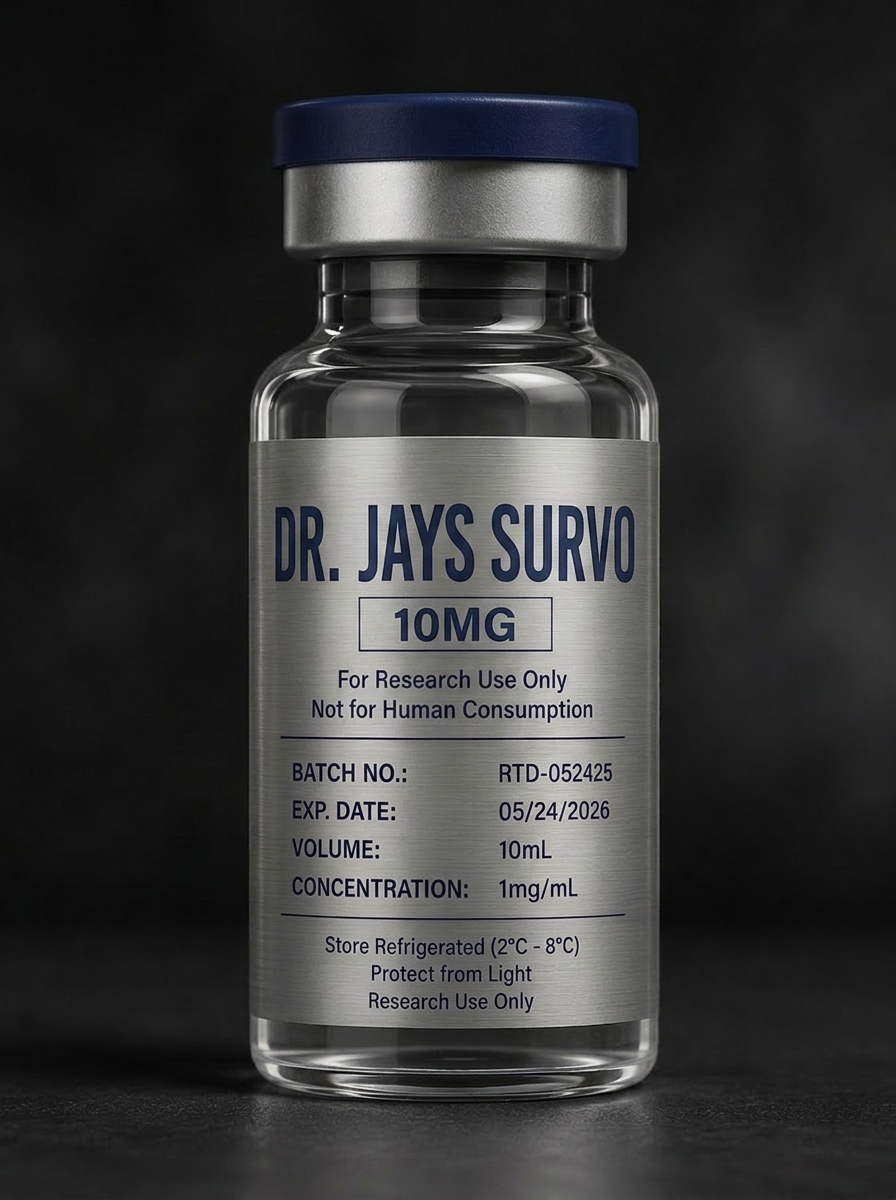
What Is Dr. Jays SURVO™ – Research Grade Peptide Compound?
Survodutide is a synthetic linear peptide with 29-30 amino acids in the backbone, engineered as a balanced dual agonist at the glucagon receptor and the GLP-1 receptor. The molecule is built on a scaffold related to the natural glucagon and GLP-1 sequences (which share substantial sequence homology because both are derived from the proglucagon precursor protein), with specific amino-acid substitutions that tune the relative activity at the two target receptors and with a fatty-acid side chain attached through a spacer that produces albumin-binding pharmacokinetics for once-weekly dosing.
The receptor-activity profile is a balanced dual-agonist profile, meaning that the compound has substantial activity at both target receptors at concentrations relevant in research and clinical contexts. The balance between the glucagon and GLP-1 receptor activities is a specific design target of the medicinal-chemistry program — different dual-agonist designs in the broader literature have different balance profiles (some with relatively more glucagon-receptor activity, others with relatively more GLP-1-receptor activity), and the specific balance profile of survodutide reflects the design decisions of its development program at Boehringer Ingelheim.
The lipidation strategy is similar in concept to that used in cagrilintide, semaglutide, and other long-acting peptides developed using the broader long-acting-peptide engineering technology platform. A fatty-acid side chain is attached through a spacer (typically including a glutamic-acid residue and/or other linker chemistry) to a specific lysine residue, producing albumin-binding pharmacokinetics that extend the elimination half-life into the multi-day range and support once-weekly administration.
The integrated effect profile of survodutide engages both the glucagon-receptor pharmacology (energy-expenditure-related effects through hepatic and other tissue sites) and the GLP-1-receptor pharmacology (insulin-secretion, glucagon-suppression, satiety-signaling, and gastric-emptying effects through pancreatic and central nervous system sites). The complementary nature of the two receptor systems is the central pharmacological rationale for the dual-agonist design.
It is worth being specific about what survodutide is not. It is not a pure GLP-1 receptor agonist — it has substantial activity at the glucagon receptor as well, distinguishing it from semaglutide, liraglutide, and other GLP-1-selective compounds. It is not a triple agonist — survodutide engages two receptor systems (glucagon and GLP-1), distinguishing it from retatrutide and other triple-agonist compounds that engage GIP, GLP-1, and glucagon in a single molecule. And it is not a GIP receptor agonist — survodutide does not engage GIP, distinguishing it from tirzepatide, which is a GIP/GLP-1 dual agonist.
History and Development
Survodutide's development sits inside the broader contemporary history of dual-and-multi-agonist peptide engineering in the metabolic-research space.
The conceptual foundation for dual glucagon / GLP-1 agonism was laid in the 2000s with research on the natural peptide oxyntomodulin, a 37-amino-acid peptide produced (like GLP-1 and glucagon) from the proglucagon precursor protein. Oxyntomodulin is a natural balanced dual agonist at the glucagon and GLP-1 receptors — it has substantial activity at both receptors and produces integrated effects from engagement of both systems. Research on oxyntomodulin in the 2000s and 2010s characterized the integrated dual-agonist pharmacology and motivated medicinal-chemistry efforts to develop synthetic dual agonists with the same general pharmacology profile but with the engineering modifications needed for practical pharmaceutical use (chemical stability, long-acting pharmacokinetics, and tuned receptor-activity profiles).
Several pharmaceutical companies have pursued dual glucagon / GLP-1 agonist development programs through the 2010s. Boehringer Ingelheim's program produced survodutide (BI 456906) as a lead compound. The compound has been characterized in preclinical and clinical research over the past several years, including in clinical trials addressing its pharmacology in research-relevant endpoints. The compound is one of several dual glucagon / GLP-1 agonists in contemporary clinical development.
The broader dual-and-multi-agonist field has produced several other important contemporary compounds. Tirzepatide (developed at Eli Lilly, approved 2022) is a single-molecule GIP / GLP-1 dual agonist with substantial activity at both target receptors. Retatrutide (developed at Eli Lilly, in advanced clinical development) is a single-molecule triple agonist engaging GIP, GLP-1, and glucagon. The contemporary multi-receptor agonist field has emerged as one of the most active areas of metabolic-research peptide engineering, with multiple companies pursuing different combinations of receptor engagements and different balance profiles within their respective compounds.
Important milestones include the 2000s and 2010s oxyntomodulin research that motivated the dual-agonist medicinal-chemistry effort, the 2010s development of multiple synthetic dual glucagon / GLP-1 agonist programs including survodutide at Boehringer Ingelheim, and the 2020s clinical-research characterization of survodutide and related multi-receptor metabolic-research compounds.
Understanding the Science
The science of survodutide is anchored in three connected areas: the natural pharmacology of the proglucagon-derived peptide family from which it descends, the dual-agonist design that produces engagement of both the glucagon receptor and the GLP-1 receptor in a single molecule, and the integrated effect profile of simultaneous engagement of both signaling systems.
Proglucagon-derived peptide family
Glucagon and GLP-1 are both produced from the proglucagon precursor protein through tissue-specific post-translational processing. In pancreatic alpha cells, proglucagon is processed primarily to produce glucagon (a 29-amino-acid peptide that signals at the glucagon receptor on hepatic and other tissue sites to promote energy mobilization, gluconeogenesis, and related effects). In intestinal L cells and in some brainstem neurons, proglucagon is processed primarily to produce GLP-1 (a 30-amino-acid peptide that signals at the GLP-1 receptor on pancreatic beta cells, central nervous system sites, and various peripheral tissues to produce the incretin-mimetic effects on insulin secretion, satiety, and gastric emptying). The two peptides share substantial sequence homology because of their shared precursor origin, and oxyntomodulin (another proglucagon-derived peptide) is a natural balanced dual agonist at both receptors.
Dual-agonist design
The dual-agonist design of survodutide engineers a single synthetic peptide molecule to engage both the glucagon receptor and the GLP-1 receptor with substantial activity at both. The design strategy builds on the natural balanced-agonist pharmacology of oxyntomodulin, with specific amino-acid substitutions that tune the relative receptor activities and that confer chemical stability and metabolic stability appropriate to a long-acting pharmaceutical-development context. The relative activity at the two receptors is a specific design target — survodutide is engineered for a particular balance profile that reflects the development decisions of the Boehringer Ingelheim program.
Glucagon receptor pharmacology
The glucagon receptor is a class B G-protein-coupled receptor expressed prominently on hepatocytes and on various other tissue sites. Activation of the receptor by glucagon (or by a synthetic glucagon-receptor agonist) signals through Gs-coupled adenylyl-cyclase activation and elevation of intracellular cyclic AMP, with downstream effects on hepatic glucose production, lipolysis, ketogenesis, energy expenditure, and various other metabolic processes. The glucagon-receptor component of survodutide's pharmacology contributes the energy-expenditure-related effects that complement the GLP-1-receptor component's effects.
GLP-1 receptor pharmacology
The GLP-1 receptor is a class B G-protein-coupled receptor expressed prominently on pancreatic beta cells, on pancreatic alpha cells, in the central nervous system, and on various peripheral tissue sites. Activation of the receptor produces glucose-dependent stimulation of insulin secretion from pancreatic beta cells, suppression of glucagon secretion from pancreatic alpha cells, satiety signaling at central GLP-1-receptor-expressing neuronal populations, and slowing of gastric emptying. The GLP-1-receptor component of survodutide's pharmacology contributes these effects, complementary to the glucagon-receptor effects.
Lipidation and the long-acting pharmacokinetic profile
The lipidation modification on survodutide produces albumin-binding pharmacokinetics suitable for once-weekly administration, analogous in concept to the lipidation strategies used in cagrilintide, semaglutide, and other long-acting lipidated peptides. The fatty-acid side chain binds reversibly and with high affinity to circulating serum albumin after subcutaneous administration, producing a circulating depot of albumin-bound peptide that releases free peptide gradually into the free-peptide pool that engages the target receptors. The elimination half-life in the multi-day range supports once-weekly dosing in research and clinical contexts.
- Survodutide (also referenced as BI 456906) is a synthetic long-acting balanced dual agonist at the glucagon receptor and the GLP-1 receptor.
- Developed at Boehringer Ingelheim as part of the broader contemporary multi-receptor metabolic-research peptide engineering field.
- Engages two complementary receptor systems — glucagon-receptor pharmacology for energy-expenditure effects and GLP-1-receptor pharmacology for insulin-secretion, satiety, and gastric-emptying effects.
- Built on the conceptual foundation of natural oxyntomodulin, a proglucagon-derived peptide that is a natural balanced dual agonist at the two receptors.
- Long-acting pharmacokinetic profile produced by lipidation-driven albumin binding, supporting once-weekly dosing.
Structural Characteristics
Structurally, survodutide is a linear peptide with 29-30 amino acids in the backbone and a fatty-acid side chain conjugated through a spacer at a specific lysine residue. The amino-acid sequence is engineered on a scaffold related to the natural glucagon and GLP-1 sequences (which share substantial sequence homology due to their shared proglucagon precursor origin) with specific substitutions that tune the relative receptor-activity balance and that confer chemical and metabolic stability appropriate to a long-acting pharmaceutical-development context.
The molecular mass of survodutide is in the broad range of 3700-4100 daltons, depending on the specific scaffold and modification configuration. The lipidated portion contributes a meaningful portion of the total mass relative to the bare-peptide scaffold, as is typical of long-acting lipidated peptides developed using contemporary engineering platforms.
The fatty-acid side chain is the defining structural innovation that produces the long-acting pharmacokinetic profile. The specific fatty-acid chemistry, the spacer chemistry, and the position of attachment on the peptide scaffold are deliberate design choices that influence the albumin-binding affinity, the elimination half-life, and the relationship between the lipidated portion of the molecule and the receptor-engagement portion of the molecule. The general principle is the same as that used in cagrilintide, semaglutide, and other long-acting lipidated peptides, with the specific design tuned for the survodutide pharmacological profile.
The combined structural design — engineered amino-acid scaffold for dual receptor activity, fatty-acid side chain for long-acting pharmacokinetics, specific spacer chemistry for albumin-binding optimization, and metabolic-stability modifications for protection against proteolytic degradation — produces a molecule with the receptor-binding pharmacology of a balanced dual glucagon / GLP-1 agonist and the pharmacokinetic profile of a long-acting depot peptide suitable for once-weekly administration. The integrated structure-pharmacokinetic-pharmacodynamic relationship is a representative example of contemporary multi-receptor long-acting peptide engineering.
Areas of Scientific Interest
Survodutide is studied in laboratory contexts that span dual-agonist receptor pharmacology, glucagon and GLP-1 receptor signaling integration, satiety-signaling and energy-balance research, and broader multi-receptor peptide engineering.
In dual-agonist receptor pharmacology, survodutide serves as a representative balanced dual glucagon / GLP-1 agonist for studies on the principles of dual-agonist design, on the receptor-binding profiles and relative-activity tuning across the two target receptors, on the structure-activity relationships within the broader dual-glucagon-GLP-1 agonist scaffold family, and on the comparative pharmacology of different dual-agonist compounds within the broader research field.
In glucagon and GLP-1 receptor signaling integration research, survodutide is studied in research on the integrated downstream signaling at the cellular and tissue level when both receptor systems are engaged simultaneously by a single molecule, on the integration of glucagon-receptor signaling (energy expenditure, hepatic effects) with GLP-1-receptor signaling (insulin secretion, satiety, gastric emptying), and on the differences and similarities between single-molecule dual-agonist engagement and multi-compound combination engagement of the same two receptor systems.
In satiety-signaling and energy-balance research, survodutide appears in research on the chronic effects of sustained dual glucagon / GLP-1 receptor engagement on energy-balance endpoints, on the integration of energy-expenditure and food-intake regulation through the dual-agonist pharmacology, and on the comparative effects of dual-agonist pharmacology versus GLP-1-selective pharmacology on the various metabolic and satiety-related endpoints.
In broader multi-receptor peptide engineering research, survodutide serves as a representative example of single-molecule dual-receptor agonism, in contrast to the multi-compound combination approach exemplified by Cagri-Sema and to the single-molecule triple-receptor agonism exemplified by retatrutide. The compound is used in methodology-research contexts on the principles of multi-receptor agonist design, on the relationship between sequence modifications and receptor-activity tuning, and on the broader principles of contemporary metabolic-peptide engineering.
Across all of these contexts, the research applications in the research-peptide supply context are laboratory and analytical in nature. The compound's status as an investigational compound in clinical research is a separate channel from the research-peptide supply for laboratory work.
Comparison With Related Compounds
Survodutide sits within the contemporary landscape of multi-receptor metabolic-research peptides, with related but distinguishable comparators across the dual-agonist, triple-agonist, single-receptor, and natural-peptide categories.
| Compound | Classification | Distinguishing feature |
|---|---|---|
| Oxyntomodulin | Natural 37-amino-acid proglucagon-derived peptide | Natural balanced dual agonist at the glucagon and GLP-1 receptors; the conceptual ancestor of synthetic dual-agonist design; rapidly degraded in plasma without engineering modifications. |
| Tirzepatide | Single-molecule GIP / GLP-1 dual agonist | Different dual-agonist combination (GIP and GLP-1 rather than glucagon and GLP-1); developed at Eli Lilly; approved 2022; different pharmacological pillars and different integrated effect profile. |
| Retatrutide | Single-molecule GIP / GLP-1 / glucagon triple agonist | Extension of the multi-receptor concept to three receptor systems in a single molecule; engages all three of GIP, GLP-1, and glucagon; in advanced clinical development at Eli Lilly. |
| Semaglutide | Selective long-acting GLP-1 receptor agonist | Single-receptor agonism at the GLP-1 receptor only; does not engage glucagon receptor; reference compound for GLP-1-selective pharmacology comparison with survodutide's dual-agonist pharmacology. |
| Glucagon | Natural 29-amino-acid pancreatic hormone | Selective for the glucagon receptor; the natural ligand for the glucagon-receptor portion of survodutide's dual-agonist pharmacology; rapidly degraded in plasma without engineering modifications. |
Frequently Asked Questions
Q.What is survodutide?
Survodutide is a synthetic long-acting peptide engineered as a balanced dual agonist at the glucagon receptor and the GLP-1 receptor. It was developed at Boehringer Ingelheim (where it is also referenced as BI 456906) as part of the broader contemporary multi-receptor metabolic-research peptide engineering field. The compound engages both target receptors with substantial activity at concentrations relevant in research and clinical contexts, producing integrated effects from simultaneous engagement of the two receptor systems.
Q.How does survodutide work?
Survodutide is a balanced dual agonist at the glucagon receptor and the GLP-1 receptor. The GLP-1-receptor component of its pharmacology produces effects on insulin secretion, glucagon suppression, satiety signaling, and gastric emptying through engagement of GLP-1 receptors on pancreatic and central nervous system tissues. The glucagon-receptor component of its pharmacology produces effects on hepatic energy expenditure, lipolysis, ketogenesis, and related metabolic processes through engagement of glucagon receptors on hepatic and other tissues. Both receptor-engagement pathways signal through Gs / cyclic AMP / PKA cascades at the receptor level, with the integrated effects produced downstream.
Q.How is survodutide different from semaglutide?
Different receptor profile. Semaglutide is a selective GLP-1 receptor agonist — it engages the GLP-1 receptor and does not have significant activity at the glucagon receptor. Survodutide is a balanced dual agonist — it engages both the glucagon receptor and the GLP-1 receptor with substantial activity at concentrations relevant in research and clinical contexts. The integrated effect profile of survodutide therefore includes both the GLP-1-receptor effects (similar in principle to those of semaglutide) and the glucagon-receptor effects (which semaglutide does not produce because it lacks glucagon-receptor activity).
Q.How is survodutide different from tirzepatide?
Different dual-agonist combination. Tirzepatide is a dual agonist at the GIP receptor and the GLP-1 receptor. Survodutide is a dual agonist at the glucagon receptor and the GLP-1 receptor. The GLP-1-receptor component is shared between the two compounds; the second receptor is different (GIP for tirzepatide, glucagon for survodutide), and the second-receptor pharmacology is therefore different — GIP signaling at GIP-receptor sites for tirzepatide versus glucagon signaling at glucagon-receptor sites for survodutide.
Q.How is survodutide different from retatrutide?
Different number of receptor engagements. Survodutide is a dual agonist engaging two receptors (glucagon and GLP-1). Retatrutide is a triple agonist engaging three receptors (GIP, GLP-1, and glucagon) in a single molecule. The two compounds share the GLP-1-and-glucagon receptor engagement; retatrutide adds GIP-receptor engagement that survodutide does not have. The triple-agonist design is a further extension of the multi-receptor agonist concept beyond the dual-agonist designs.
Q.What is oxyntomodulin and how is it related?
Oxyntomodulin is a natural 37-amino-acid peptide produced from the proglucagon precursor protein in intestinal L cells (the same cells that also produce GLP-1 from the same precursor). Oxyntomodulin is a natural balanced dual agonist at the glucagon receptor and the GLP-1 receptor. Research on oxyntomodulin in the 2000s and 2010s established the principle that dual glucagon / GLP-1 engagement produces integrated metabolic effects exceeding those of GLP-1 engagement alone, motivating the medicinal-chemistry efforts to develop synthetic dual agonists with the same general pharmacology but with the engineering modifications needed for practical pharmaceutical use.
Q.Who developed survodutide?
Survodutide was developed at Boehringer Ingelheim, the German pharmaceutical company, as part of its dual-agonist peptide-engineering program. The compound is referenced in some literature by its development code BI 456906. The compound has been characterized in preclinical and clinical research over the past several years and is in active clinical development at Boehringer Ingelheim as of recent updates.
Q.Why combine glucagon and GLP-1 receptor agonism?
The two receptor systems have complementary integrated effects in metabolic physiology. GLP-1 signaling promotes glucose-dependent insulin secretion, suppresses glucagon secretion, slows gastric emptying, and signals satiety. Glucagon signaling promotes hepatic energy expenditure through several mechanisms including lipolysis and ketogenesis. The hypothesis underlying dual agonism is that simultaneous engagement of both systems can produce integrated metabolic effects exceeding the effects of either system alone — with the glucagon-receptor component contributing energy-expenditure-related effects that complement the GLP-1-receptor component's effects on insulin secretion, satiety, and gastric emptying.
Q.Wouldn't glucagon raise blood glucose?
Glucagon-receptor signaling alone tends to promote hepatic glucose production and would by itself tend to elevate blood glucose. The dual-agonist design balances the glucagon-receptor component with the GLP-1-receptor component, which produces glucose-dependent insulin secretion and other glycemic-control effects that counterbalance the glycemic effects of the glucagon-receptor component. The integrated effect of a balanced dual agonist is the result of both pharmacology contributions together rather than the effect of either alone.
Q.What is the molecular weight of survodutide?
Survodutide has a molecular mass in the broad range of 3700-4100 daltons, depending on the specific scaffold and modification configuration. The 29-30-amino-acid peptide backbone contributes the bulk of the mass, with the fatty-acid side chain and the spacer chemistry contributing additional mass relative to the bare-peptide scaffold. The exact mass for a particular batch is reported on the Certificate of Analysis from a reputable research-peptide supplier and confirmed by mass spectrometry.
Q.How is survodutide administered in research contexts?
In published research and clinical literature, survodutide is administered by subcutaneous injection on a once-weekly schedule, supported by the multi-day elimination half-life produced by the lipidation-driven albumin-binding pharmacokinetics. The peptide structure is not orally bioavailable in any practical way — like most peptides, the molecule would be degraded in the gastrointestinal tract before significant absorption. The research-peptide supply context contemplates laboratory and analytical work rather than personal administration.
Q.What does the fatty-acid side chain do?
The fatty-acid side chain produces the long-acting pharmacokinetic profile that supports once-weekly administration. The side chain binds reversibly and with high affinity to circulating serum albumin after subcutaneous administration. The albumin-bound peptide is protected from renal filtration and from proteolytic degradation, and it serves as a circulating depot that releases free peptide gradually into the free-peptide pool that engages the target receptors. The combined effect is an elimination half-life in the multi-day range. This is the same general engineering principle used in cagrilintide, semaglutide, and other contemporary long-acting lipidated peptides.
Q.Is survodutide approved as a medicine?
Survodutide is an investigational compound that has been the subject of extensive preclinical and clinical research at Boehringer Ingelheim. As of the most recent updates, the compound is in advanced clinical development. The research-peptide supply of the compound for laboratory work is a separate channel from the Boehringer Ingelheim clinical-research program and from any approved-product channels.
Q.What storage and reconstitution practices apply?
Lyophilized survodutide stored sealed at -20 °C or below away from light is generally considered stable for extended periods. The engineered scaffold and the lipidation modifications give the compound good chemical stability relative to a native-sequence peptide. After reconstitution in sterile water or bacteriostatic water, the compound is typically stored refrigerated and used within several weeks. Standard research-laboratory storage and handling practices apply.
Q.How is survodutide manufactured?
Research-grade survodutide is produced by solid-phase peptide synthesis using Fmoc protecting-group chemistry, with the linear precursor assembled on a suitable resin. The fatty-acid side-chain conjugation is performed at a specific lysine residue using selective protecting-group strategies to direct the modification to the intended site. The crude lipidated peptide is purified by reversed-phase HPLC and characterized by mass spectrometry and other analytical methods. The synthesis of a long-acting lipidated multi-receptor agonist is more complex than that of a simple unmodified peptide.
Q.Is survodutide safe?
Comprehensive safety characterization of survodutide is ongoing as part of the clinical-research program at Boehringer Ingelheim. The compound's safety profile in research and clinical contexts continues to be characterized in the various studies addressing its dual-agonist pharmacology. The research-peptide supply of the compound for laboratory work is a separate channel from the clinical-research channel; the comprehensive safety characterization is applicable to the clinical-research context rather than to laboratory research-peptide use. Educational discussion should remain within the laboratory-research and clinical-research framings appropriate to the actual use channels.
Glossary of Terms
- Survodutide
- Synthetic long-acting peptide engineered as a balanced dual agonist at the glucagon receptor and the GLP-1 receptor; developed at Boehringer Ingelheim (BI 456906).
- Dual agonist
- A single molecule that engages two distinct receptors with substantial activity at both; the design strategy used in survodutide, tirzepatide, and other contemporary multi-receptor metabolic-research peptides.
- Glucagon receptor
- Class B G-protein-coupled receptor expressed prominently on hepatocytes; one of the two target receptors of survodutide's dual-agonist pharmacology.
- GLP-1 receptor
- Class B G-protein-coupled receptor expressed on pancreatic beta cells and other tissues; the other target receptor of survodutide's dual-agonist pharmacology.
- Oxyntomodulin
- Natural 37-amino-acid proglucagon-derived peptide that is a natural balanced dual agonist at the glucagon and GLP-1 receptors; the conceptual ancestor of synthetic dual-agonist design.
- Proglucagon
- Precursor protein from which glucagon, GLP-1, oxyntomodulin, and several other peptide hormones are produced by tissue-specific post-translational processing.
- Lipidation
- Attachment of a fatty-acid side chain to a peptide; the engineering strategy that produces the long-acting albumin-binding pharmacokinetics of survodutide.
- Albumin binding
- Reversible binding of the lipidated peptide to circulating serum albumin; the pharmacokinetic mechanism that extends the elimination half-life into the multi-day range.
- Balanced agonist
- A dual-agonist or multi-agonist molecule with substantial activity at all its target receptors, as opposed to an unbalanced multi-agonist with much greater activity at one target than the others.
- BI 456906
- Development code for survodutide at Boehringer Ingelheim; the compound is referenced in some literature by this code.
Summary
Survodutide (also referenced as BI 456906) is a synthetic long-acting peptide engineered as a balanced dual agonist at the glucagon receptor and the GLP-1 receptor. The compound sits within the contemporary class of multi-receptor metabolic-research peptides — a research direction that has produced tirzepatide (GIP/GLP-1 dual agonist), retatrutide (GIP/GLP-1/glucagon triple agonist), and survodutide itself — that addresses the integration of multiple incretin-and-glucagon signaling systems in single molecules.
The conceptual foundation for the dual-agonist design is rooted in the recognition that glucagon and GLP-1 are evolutionarily related class B GPCRs derived from a common ancestral signaling system, and that the natural peptide oxyntomodulin is a balanced dual agonist at both receptors with integrated metabolic effects from simultaneous engagement of both systems. Survodutide is a synthetic engineering of this natural dual-agonist pharmacology, with specific amino-acid substitutions that tune the receptor-activity balance and with a fatty-acid side chain that produces long-acting albumin-binding pharmacokinetics for once-weekly dosing.
The mechanism engages both target receptors simultaneously. The GLP-1-receptor component produces the incretin-mimetic effects on insulin secretion, glucagon suppression, satiety signaling, and gastric emptying that are characteristic of GLP-1 receptor agonism in general. The glucagon-receptor component produces effects on hepatic energy expenditure, lipolysis, ketogenesis, and other metabolic processes through engagement of glucagon receptors on hepatic and other tissue sites. The integrated effect profile of the dual agonism is the result of both components together, with the balance of the two contributions tuned by the specific receptor-activity profile of the molecule.
Survodutide is an investigational compound in active clinical development at Boehringer Ingelheim. The research-peptide supply of the compound for laboratory work is a separate channel from the Boehringer Ingelheim clinical-research program. The compound's published research footprint spans dual-agonist receptor pharmacology, glucagon and GLP-1 receptor signaling integration, satiety-signaling and energy-balance research, and broader multi-receptor peptide engineering research.
For students, researchers, and curious readers approaching survodutide for the first time, the most accurate framing is of a thoughtfully engineered single-molecule dual glucagon / GLP-1 agonist with a well-defined balanced receptor-activity profile, a distinctive lipidation-based long-acting pharmacokinetic design, and a defined place within the broader contemporary multi-receptor metabolic-research landscape — distinguished from selective GLP-1-receptor agonists by the dual-agonist activity at glucagon receptors, distinguished from tirzepatide by the dual-agonist combination (glucagon/GLP-1 rather than GIP/GLP-1), and distinguished from retatrutide by the dual-agonist rather than triple-agonist receptor coverage.
Scientific References
Selected peer-reviewed and primary-source citations used to inform this educational overview. Inclusion does not imply endorsement of any non-research use of Dr. Jays SURVO™ – Research Grade Peptide Compound.
- Zimmermann, T., et al. (2022). BI 456906: Discovery and preclinical pharmacology of a novel GCGR/GLP-1R dual agonist with robust anti-obesity efficacy. Molecular Metabolism, 66, 101633.Foundational preclinical-pharmacology characterization of survodutide (BI 456906) as a dual glucagon / GLP-1 receptor agonist.
- Le Roux, C. W., et al. (2024). Glucagon and GLP-1 receptor dual agonist survodutide for obesity: a randomised, double-blind, placebo-controlled, dose-finding phase 2 trial. Lancet Diabetes & Endocrinology, 12(3), 162-173.Representative Phase 2 clinical-research characterization of survodutide pharmacology and tolerability in research-relevant endpoints.
- Pocai, A., et al. (2009). Glucagon-like peptide 1/glucagon receptor dual agonism reverses obesity in mice. Diabetes, 58(10), 2258-2266.Foundational preclinical research on the dual glucagon / GLP-1 agonist concept that motivated subsequent medicinal-chemistry efforts including survodutide.
- Day, J. W., et al. (2009). A new glucagon and GLP-1 co-agonist eliminates obesity in rodents. Nature Chemical Biology, 5(10), 749-757.Foundational synthetic dual-agonist design research that established principles applied in subsequent dual-agonist programs including survodutide.