
Introduction
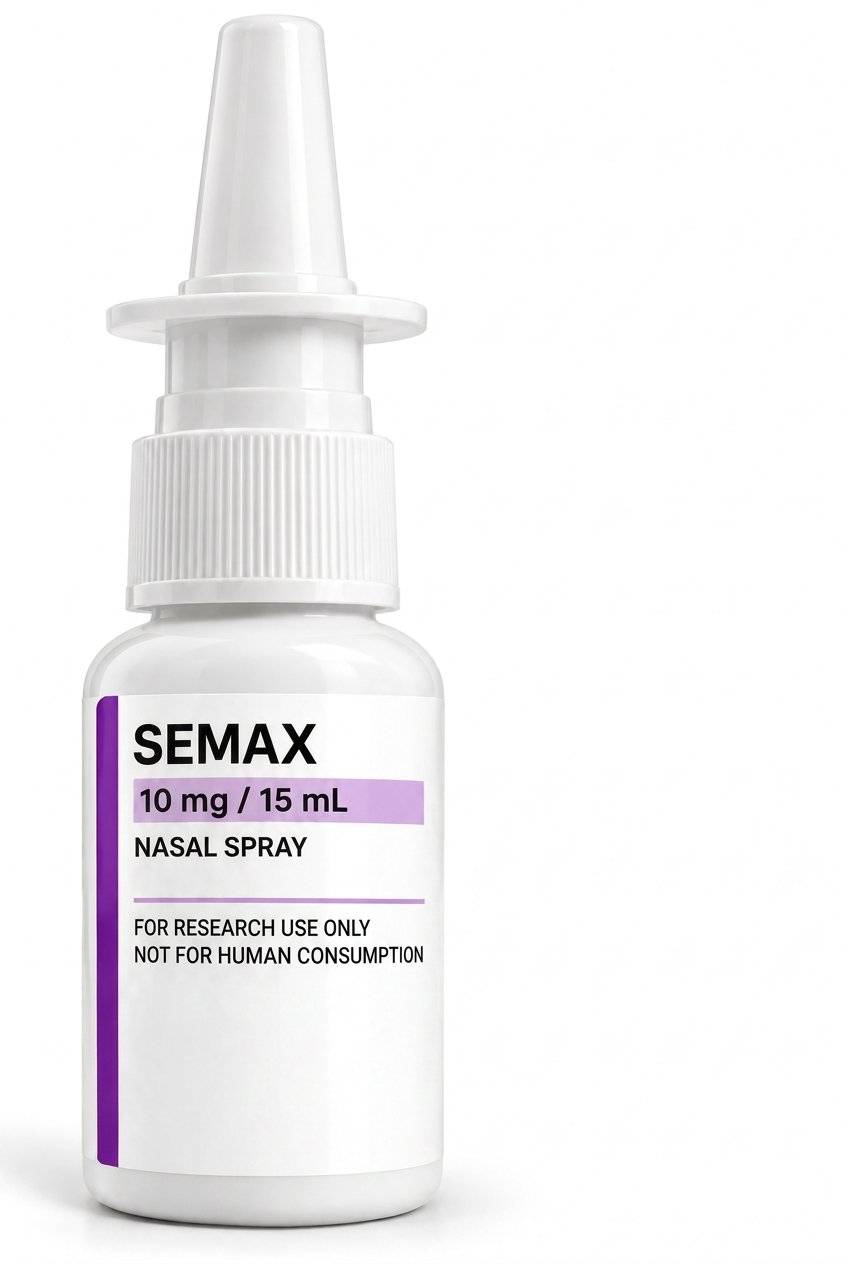
Semax nasal spray is the pre-formulated intranasal delivery format of Semax, a synthetic heptapeptide developed at the Institute of Molecular Genetics (Russian Academy of Sciences) in the 1980s and registered in the Russian Federation as a neurological compound. The peptide sequence is Met-Glu-His-Phe-Pro-Gly-Pro (MEHFPGP) — a modification of the ACTH(4-10) fragment of adrenocorticotropic hormone, with the C-terminal tripeptide PGP added to confer protease resistance and improve pharmacokinetic stability.
The nasal-spray format reflects the standard delivery route for Semax in the Russian neurological research and clinical contexts in which the molecule was developed and is used. Intranasal administration of small peptides provides an alternative to parenteral administration that bypasses first-pass hepatic metabolism, can produce systemic exposure with appropriate formulation, and may provide direct nose-to-brain transport along olfactory and trigeminal pathways for CNS-active peptides. The nose-to-brain delivery concept is an active area in peptide pharmacology and is part of the rationale for the intranasal Semax format.
Semax is part of the broader Russian neuropeptide research program that produced several related compounds, including Selank (a tuftsin-derived heptapeptide with anxiolytic-research focus) and a series of melanocortin-system-derived peptides. The published Russian research literature on Semax spans neuroprotection, cognitive enhancement in research contexts, post-stroke neurological recovery, attention and learning, and BDNF/NGF upregulation. The molecule is registered for medical use in the Russian Federation and several adjacent countries; it has not received approval from the US FDA, EMA, or other major Western regulatory agencies.
This page is a research-only educational reference. Semax nasal spray supplied as a research-formatted product is intended for laboratory and analytical work; no therapeutic or human-use claims are made.
What Is Semax Nasal Spray?
Semax is a synthetic heptapeptide with the sequence Met-Glu-His-Phe-Pro-Gly-Pro (MEHFPGP, single-letter). The N-terminal tetrapeptide MEHF corresponds to the ACTH(4-7) fragment of adrenocorticotropic hormone — a sequence that lies within the melanocortin family and that is shared across ACTH, alpha-MSH, beta-MSH, and gamma-MSH. The C-terminal tripeptide PGP is appended to confer protease resistance and to extend the in-vivo half-life of the molecule compared to the unmodified ACTH(4-10) fragment.
The native ACTH peptide is the 39-amino-acid product of POMC (proopiomelanocortin) processing in the anterior pituitary, and it has two principal biological roles: the C-terminal portion mediates the steroidogenic effects at the adrenal cortex (the classical "ACTH" function), while the N-terminal portion contains the melanocortin sequence shared with alpha-MSH and related peptides that act on melanocortin receptors in skin (pigmentation) and brain (appetite, behavior, neuroprotection). The ACTH(4-10) fragment was identified in the 1960s-70s as having neurotropic and behavioral effects in animal models without the steroidogenic effects of full ACTH — the basis for the medicinal-chemistry interest in ACTH-derived neuroactive peptides that produced Semax.
The mechanism of action of Semax in the published Russian research literature involves multiple proposed targets and pathways. Reported effects include upregulation of brain-derived neurotrophic factor (BDNF) and nerve growth factor (NGF) gene expression in hippocampus and other brain regions, modulation of the dopaminergic and serotonergic systems, neuroprotective effects in ischemic and toxic neuronal-injury models, and behavioral effects on learning, attention, and memory in animal-research paradigms. The receptor targets are not definitively established; some published work implicates melanocortin receptors (likely MC4R given the ACTH(4-10) origin) and some implicates non-receptor mechanisms.
In the intranasal format, Semax is supplied as an aqueous nasal-spray formulation typically at 0.1% (1 mg/mL) concentration in a metered-spray device. The 10mg labeled strength reflects the total peptide content of the device. Russian medical literature and clinical-research publications describe specific dosing protocols for the intranasal route; this page does not reproduce those protocols and is research-context only.
It is important to be clear about what Semax is not. It is not ACTH itself — it shares only the N-terminal melanocortin sequence and lacks the steroidogenic activity of full ACTH. It is not approved as a medicine in major Western jurisdictions. And it is not a "smart drug" or "nootropic" in any approved sense; the published nootropic literature on Semax is largely Russian-language and has not been replicated in independent Western clinical research at scale.
History and Development
The Russian neuropeptide research program that produced Semax began in the 1970s at the Institute of Molecular Genetics of the Russian Academy of Sciences and at allied institutions. The program was motivated by the broader recognition in international neuroendocrinology that short peptide fragments of hormones — particularly fragments of ACTH and MSH within the melanocortin family — had neurotropic, behavioral, and cognitive effects distinct from the full hormone's classical endocrine functions. The ACTH(4-10) fragment was a focal point of this work, with research groups in the Netherlands (David de Wied's laboratory at Utrecht), the United States, and the Soviet Union characterizing behavioral and cognitive effects of the fragment in animal models.
Semax was designed in the 1980s by extending the ACTH(4-7) tetrapeptide MEHF with a C-terminal PGP tripeptide chosen to confer protease resistance. The PGP extension was a deliberate medicinal-chemistry choice to address the rapid degradation of unmodified ACTH(4-10) by aminopeptidases and other peptidases in serum and tissue. The resulting heptapeptide MEHFPGP combined the neuroactive ACTH(4-7) core with the protease-resistant PGP tail, producing a molecule with substantially better in-vivo stability than the unmodified ACTH(4-10) fragment.
Through the 1990s, Semax was characterized in the Russian published research literature in animal models of neuroprotection (ischemic stroke, toxic insults), in behavioral and cognitive-function paradigms, and in molecular-mechanism investigations focused on BDNF and NGF upregulation. The molecule was registered for medical use in the Russian Federation in 1994 for the treatment of cerebrovascular disease and related neurological indications, and the intranasal formulation became the standard delivery route. Selank, a related Russian-developed heptapeptide with a tuftsin-derived sequence and anxiolytic-research focus, was developed in parallel and registered in Russia in subsequent years.
The published Russian clinical-research literature on Semax includes work on post-stroke neurological recovery, optic-nerve disorders, attention deficit and learning difficulties in pediatric populations, and other neurological indications consistent with the molecule's registered uses in Russia. The literature is largely Russian-language and has limited independent Western replication. As a result, Semax remains essentially unknown in Western clinical practice and has not been pursued through Western regulatory development.
Outside the registered medical context in Russia and adjacent countries, Semax has been adopted as a research peptide and as a "nootropic" in lay and gray-market use. The lay nootropic adoption has not been accompanied by independent Western clinical-research validation of the cognitive-enhancement claims. The molecule's status as a research peptide for laboratory and analytical work is the appropriate framing in the research-supply context covered by this page.
Understanding the Science
The melanocortin family of peptides — derived from the POMC precursor — includes ACTH, alpha-MSH, beta-MSH, and gamma-MSH, together with the ACTH-derived neuroactive fragments. The melanocortin receptors (MC1R through MC5R) are class A GPCRs distributed across skin (MC1R, pigmentation), adrenal cortex (MC2R, steroidogenesis — the classical ACTH receptor), brain (MC3R, MC4R — appetite and metabolic regulation), and other tissues (MC5R). The ACTH(4-10) fragment that forms the core of Semax interacts with brain melanocortin receptors (MC4R is one candidate) at low affinity in the published binding literature.
In addition to potential melanocortin-receptor signaling, the published Semax research literature describes several other proposed mechanistic targets. Brain-derived neurotrophic factor (BDNF) and nerve growth factor (NGF) gene expression is upregulated in hippocampus and other brain regions in published animal-model studies of Semax administration. BDNF and NGF are the principal neurotrophins involved in adult brain plasticity, neuronal survival, and synaptic function; their upregulation is one mechanistic candidate for the neuroprotective and cognitive effects reported in the literature.
The Russian published research on Semax in animal models of ischemic brain injury reports neuroprotective effects including reduced infarct size, improved neurological function, and reduced apoptotic neuronal loss. The mechanistic candidates include neurotrophin upregulation, anti-inflammatory effects, antioxidant effects, and modulation of glutamatergic excitotoxicity. The breadth of mechanistic candidates and the relative absence of definitive receptor-target identification are characteristic features of the Semax literature.
Behavioral and cognitive-function studies in animal models report effects on learning, memory, attention, and stress-coping in various paradigms. The published cognitive-enhancement literature on Semax in human research is largely Russian-language and includes investigations in healthy subjects, in attention-deficit conditions, and in post-stroke cognitive recovery. The literature has not been replicated independently at scale in Western clinical research.
The intranasal delivery route is a distinctive feature of the Semax pharmacology. Intranasal administration of small peptides provides systemic exposure (via nasal mucosal absorption into the systemic circulation), bypasses first-pass hepatic metabolism, and may provide direct nose-to-brain transport along the olfactory and trigeminal pathways. The nose-to-brain transport mechanism is a particular focus for CNS-active peptides because it can in principle deliver intact peptide to brain regions in higher concentration than would be achieved by parenteral administration. The extent to which nose-to-brain transport contributes to Semax's CNS effects is debated in the published pharmacokinetic literature; some Russian studies present evidence consistent with direct brain entry while others suggest that systemic absorption followed by blood-brain-barrier crossing is the dominant route.
Pharmacokinetics of intranasal Semax in the published Russian literature indicate rapid mucosal absorption, short plasma half-life (consistent with the small heptapeptide character), and relatively sustained brain-region effects that may reflect downstream signaling cascades (notably BDNF/NGF transcriptional upregulation) rather than continued direct peptide presence.
Structural Characteristics
Semax is a synthetic heptapeptide with the sequence Met-Glu-His-Phe-Pro-Gly-Pro (MEHFPGP). The molecular weight is approximately 813.9 g/mol. The N-terminal MEHF tetrapeptide corresponds to ACTH(4-7); the C-terminal PGP tripeptide is a medicinal-chemistry extension chosen for protease resistance. The peptide contains a free N-terminal methionine, a free C-terminal proline (no C-terminal amidation), and a histidine residue at position 3 that contributes ionizable character.
The intranasal formulation is typically an aqueous solution at 0.1% (1 mg/mL) concentration in a buffered carrier with appropriate preservatives and tonicity agents for nasal mucosal compatibility. The 10mg labeled strength on the nasal-spray device refers to the total peptide content (typically a 10 mL volume at 1 mg/mL).
Research-grade Semax peptide for laboratory use is produced by standard solid-phase peptide synthesis (Fmoc chemistry), purified by reversed-phase HPLC to ≥98% purity, and verified by analytical HPLC and mass spectrometry. The peptide is supplied as a lyophilized powder for laboratory reconstitution or, in the nasal-spray format, as a pre-reconstituted aqueous solution in a metered-dose device. The lyophilized peptide is stable at -20 °C or below for extended periods; the nasal-spray solution has a defined shelf life under refrigeration as specified by the manufacturer.
Areas of Scientific Interest
In published Semax research, the molecule (in both lyophilized and intranasal formats) has been used in several principal applications:
Neuroprotection in ischemic injury. Rodent models of middle cerebral artery occlusion (MCAO) and related ischemic-brain-injury paradigms have been used to investigate Semax neuroprotective effects. The published Russian literature reports reduced infarct size, improved neurological function, and reduced apoptotic neuronal loss with Semax treatment in these models.
BDNF and NGF upregulation. Cultured neuronal cell lines, primary neurons, and rodent brain tissue have been used to investigate Semax-induced upregulation of BDNF and NGF gene expression. The mechanistic studies have characterized the time course, brain-region specificity, and downstream signaling consequences of the neurotrophin response.
Behavioral and cognitive paradigms. Rodent learning, memory, attention, and stress-coping paradigms have been used to investigate Semax behavioral effects. The published literature includes work on passive-avoidance learning, water-maze performance, and various other behavioral readouts.
Optic-nerve and ophthalmologic research. The Russian medical-research literature includes work on Semax in optic-nerve disorders, with the intranasal-delivery and nose-to-brain transport rationale particularly relevant given the optic nerve's CNS origin.
Pediatric attention and learning research. Published Russian clinical research has investigated Semax in pediatric attention-deficit and learning-difficulty contexts. This literature has not been independently replicated in Western clinical research.
Comparative neuropeptide research. Semax is studied alongside Selank (the related Russian-developed anxiolytic-research heptapeptide) and other neuroactive peptides in comparative neuropeptide pharmacology.
All applications in the research-supply context are research-context only. Nothing on this page describes a clinical protocol, dose, or therapy for human use outside the registered Russian medical context.
Comparison With Related Compounds
Semax sits within the Russian-developed neuropeptide research program and the broader melanocortin-family research landscape.
| Compound | Classification | Distinguishing feature |
|---|---|---|
| Semax (MEHFPGP) | ACTH(4-7)+PGP heptapeptide | Russian neurological compound; BDNF/NGF upregulation; intranasal delivery format standard. |
| Selank | Tuftsin-derived heptapeptide | Russian-developed anxiolytic-research peptide; sibling program to Semax; also intranasal format. |
| ACTH(4-10) | Unmodified native ACTH fragment | Parent neuroactive sequence; rapidly degraded; Semax-PGP extension addresses stability. |
| Alpha-MSH | 13-residue melanocortin (POMC product) | Related melanocortin-family peptide; binds melanocortin receptors with higher affinity than ACTH(4-10). |
| BDNF / NGF | Endogenous neurotrophins | Downstream effectors whose upregulation is implicated in Semax neurotropic effects. |
Frequently Asked Questions
Q.What is Semax?
Semax is a synthetic heptapeptide with the sequence MEHFPGP (Met-Glu-His-Phe-Pro-Gly-Pro) developed at the Institute of Molecular Genetics of the Russian Academy of Sciences in the 1980s. The N-terminal MEHF corresponds to the ACTH(4-7) fragment; the C-terminal PGP is a medicinal-chemistry extension for protease resistance. The molecule is registered as a neurological compound in the Russian Federation, has not been approved by major Western regulatory agencies, and is studied in published Russian research for neuroprotection, BDNF/NGF upregulation, and cognitive-function effects.
Q.What is the difference between Semax and the lyophilized peptide?
The nasal-spray format and the lyophilized peptide contain the same molecule (MEHFPGP heptapeptide). The nasal spray is a pre-formulated aqueous solution (typically 0.1% / 1 mg/mL) in a metered-dose device; the lyophilized peptide is dry powder that requires reconstitution before use. The nasal-spray format is the standard delivery route in the Russian medical and research context. Research-laboratory use may use either format depending on the experimental protocol.
Q.Why is Semax given intranasally?
Intranasal administration of small peptides bypasses first-pass hepatic metabolism, achieves rapid mucosal absorption into the systemic circulation, and may provide direct nose-to-brain transport along olfactory and trigeminal pathways. The nose-to-brain mechanism is particularly relevant for CNS-active peptides because it can in principle deliver intact peptide to brain regions at higher local concentrations than parenteral administration. The intranasal route became the standard for Semax in the Russian medical context for these reasons.
Q.What is the relationship between Semax and ACTH?
The N-terminal MEHF tetrapeptide of Semax corresponds to the ACTH(4-7) fragment of adrenocorticotropic hormone. The ACTH(4-10) region was identified in international neuroendocrinology research in the 1960s-70s as having neurotropic and behavioral effects in animal models without the steroidogenic effects of full ACTH. Semax is a protease-resistant medicinal-chemistry extension of this neuroactive fragment. It does not have ACTH's classical steroidogenic activity; it shares only the N-terminal neuroactive sequence.
Q.Is Semax approved as a medicine?
Semax is registered as a medical product in the Russian Federation and several adjacent countries for neurological indications including cerebrovascular disease and post-stroke recovery. It is not approved by the US FDA, the European EMA, or other major Western regulatory agencies, and it is essentially unknown in Western clinical practice. Outside its registered Russian medical context, Semax circulates as a research peptide and as a lay 'nootropic.' Research-supply sales are research-context, not clinical.
Q.What does Semax do to BDNF and NGF?
Published Russian research reports that Semax administration upregulates brain-derived neurotrophic factor (BDNF) and nerve growth factor (NGF) gene expression in hippocampus and other brain regions in rodent models. BDNF and NGF are the principal neurotrophins involved in adult brain plasticity, neuronal survival, and synaptic function. The neurotrophin upregulation is one of the principal mechanistic candidates proposed in the literature for Semax's reported neuroprotective and cognitive effects.
Q.Is Semax the same as Selank?
No. Semax and Selank are both Russian-developed heptapeptides from related research programs but they are distinct molecules with different structures and different research-pharmacology emphasis. Semax is an ACTH(4-7)+PGP peptide with neuroprotection and cognitive-function research focus. Selank is a tuftsin-derived heptapeptide (Thr-Lys-Pro-Arg-Pro-Gly-Pro) with anxiolytic-research focus. Both are registered medical products in Russia and are used in intranasal format.
Q.What is the receptor target of Semax?
The receptor target of Semax is not definitively established in the published literature. The ACTH(4-7) origin suggests interaction with brain melanocortin receptors (MC4R is one candidate) but binding affinities are low in the published binding literature. Some studies propose non-receptor mechanisms including direct effects on neurotrophin transcription. The mechanism remains an active research question and is one of the open issues in Semax biology.
Q.Are the cognitive effects of Semax validated in Western research?
Independent Western clinical-research validation of Semax's cognitive-enhancement effects at scale is limited. The published cognitive-enhancement literature on Semax in human research is largely Russian-language and has not been replicated independently in Western controlled clinical trials of substantial size. The molecule's reputation in lay 'nootropic' use significantly exceeds the Western-research evidence base. This page is research educational only and makes no claims about cognitive effects in any context.
Q.How is the nasal-spray Semax stored?
The pre-formulated nasal-spray product is typically stored under refrigeration (2-8 °C) as specified by the manufacturer's label, with a defined shelf life. The metered-spray device delivers a calibrated dose per actuation. Specific storage requirements, expiry dates, and handling instructions vary by manufacturer and formulation; the product label is the authoritative source. Lyophilized Semax peptide for laboratory reconstitution is stored at -20 °C or below.
Q.Can Semax be combined with Selank?
In some research contexts the two related Russian-developed peptides are studied in combination, given the complementary research-pharmacology emphasis (Semax neurotropic, Selank anxiolytic). The published research on combination use is limited, and the appropriate research framework depends on the specific scientific question. Combination use in research-supply contexts is research-context only and does not constitute clinical guidance.
Q.What is the pharmacokinetic half-life of intranasal Semax?
Published Russian pharmacokinetic studies indicate rapid intranasal mucosal absorption with a short plasma half-life consistent with the small heptapeptide character of the molecule — typically tens of minutes. Brain-region effects, particularly BDNF and NGF upregulation, are reported to persist substantially longer than the plasma exposure, consistent with downstream transcriptional consequences extending beyond direct peptide presence. The dissociation between plasma kinetics and brain-region effect duration is one of the pharmacological features of the molecule.
Glossary of Terms
- Semax
- Synthetic heptapeptide MEHFPGP; ACTH(4-7) extended with C-terminal PGP for protease resistance.
- ACTH(4-10)
- 10-residue fragment of adrenocorticotropic hormone with neurotropic and behavioral effects in animal models.
- POMC
- Proopiomelanocortin; precursor protein processed into ACTH, alpha-MSH, beta-endorphin, and related peptides.
- Melanocortin receptors
- Family of five GPCRs (MC1R-MC5R) activated by ACTH and MSH-family peptides.
- BDNF
- Brain-derived neurotrophic factor; principal neurotrophin involved in adult brain plasticity; upregulated by Semax in published research.
- NGF
- Nerve growth factor; first-identified neurotrophin (Levi-Montalcini, Cohen); upregulated by Semax in published research.
- Nose-to-brain transport
- Direct delivery of intranasally administered molecules to brain via olfactory and trigeminal pathways; bypasses BBB.
- Selank
- Sibling Russian-developed heptapeptide; tuftsin-derived; anxiolytic-research focus.
- Institute of Molecular Genetics RAS
- Russian Academy of Sciences institute where Semax was developed in the 1980s.
- Tuftsin
- Naturally occurring tetrapeptide TKPR; parent sequence for Selank's heptapeptide extension.
Summary
Semax nasal spray is the pre-formulated intranasal delivery format of Semax, a synthetic heptapeptide developed at the Institute of Molecular Genetics of the Russian Academy of Sciences in the 1980s. The sequence MEHFPGP combines the ACTH(4-7) tetrapeptide with a C-terminal PGP tripeptide chosen for protease resistance. The molecule is registered for neurological indications in the Russian Federation and is used in published Russian research for neuroprotection, BDNF/NGF upregulation, and cognitive-function effects. It has not been approved by major Western regulatory agencies and is essentially unknown in Western clinical practice.
The intranasal delivery format reflects the standard route for Semax in the Russian medical and research context and exploits the rapid mucosal absorption, first-pass-bypass, and potential nose-to-brain transport advantages of intranasal small-peptide delivery for CNS-active molecules. The 10mg labeled strength refers to the total peptide content of the metered-dose device, typically 10 mL at 0.1% (1 mg/mL) concentration.
This page is research educational only. Semax nasal spray supplied as a research-formatted product is intended for laboratory and analytical work; no therapeutic or human-use claims are made.
Scientific References
Selected peer-reviewed and primary-source citations used to inform this educational overview. Inclusion does not imply endorsement of any non-research use of Semax Nasal Spray.
- Ashmarin, I. P., Nezavibatko, V. N., Levitskaya, N. G., et al. (1995). Design and investigation of an ACTH(4-10) analog lacking D-amino acids and hydrophobic residues. Neuroscience and Behavioral Physiology, 25(3), 234–238.
- de Wied, D. (1997). Neuropeptides in learning and memory processes. Behavioural Brain Research, 83(1-2), 83–90.
- Dolotov, O. V., Karpenko, E. A., Inozemtseva, L. S., et al. (2006). Semax, an analog of adrenocorticotropin (4-10), binds specifically and increases levels of brain-derived neurotrophic factor protein in rat basal forebrain. Journal of Neurochemistry, 97(s1), 82–86.
- Gusev, E. I., Skvortsova, V. I., Miasoedov, N. F., et al. (2005). Effectiveness of semax in acute period of hemispheric ischemic stroke (a clinical and electrophysiological study). Zhurnal Nevrologii i Psikhiatrii im. S.S. Korsakova, 105(3), 28–33.
- Illum, L. (2003). Nasal drug delivery — possibilities, problems and solutions. Journal of Controlled Release, 87(1-3), 187–198.