
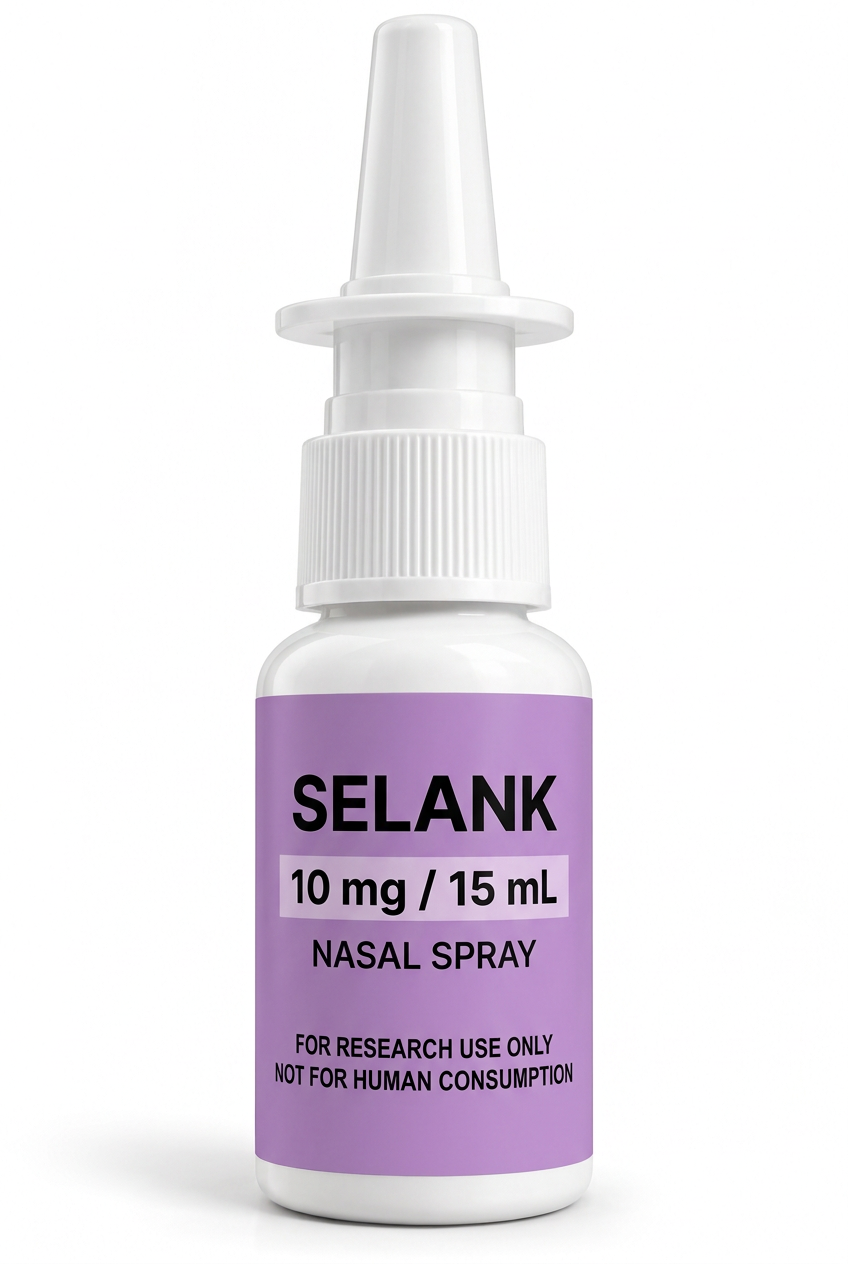
Introduction
Selank is a synthetic heptapeptide with sequence Thr-Lys-Pro-Arg-Pro-Gly-Pro developed in Russian neuropeptide-pharmacology research at the Institute of Molecular Genetics of the Russian Academy of Sciences and the V. V. Zakusov Institute of Pharmacology. The molecule is a synthetic analog of the endogenous immunopeptide tuftsin (Thr-Lys-Pro-Arg, a tetrapeptide derived from the CH2 domain of immunoglobulin G heavy chains) with a C-terminal Pro-Gly-Pro extension that confers metabolic stability and enables CNS-active intranasal pharmacology. The Selank Nasal Spray product is the intranasal research-format preparation of the same Selank peptide that is supplied as a standalone research peptide in the broader catalog.
This page is the research-only educational reference for the intranasal-format Selank preparation. The molecule has historical regulatory status as a registered medicine in Russia and some post-Soviet jurisdictions for specific indications but is NOT approved by the US FDA, the EMA, or other major Western regulatory authorities. No medical or therapeutic claims are made on this page. For full background on the Selank peptide molecule, refer to the standalone Selank product page in this catalog.
What Is Selank Nasal Spray?
Selank Nasal Spray is the intranasal-format preparation of Selank, a synthetic heptapeptide Thr-Lys-Pro-Arg-Pro-Gly-Pro with molecular weight approximately 751 g/mol. The peptide is formulated in an aqueous solution at a standardized concentration in a metered-dose nasal spray container. The intranasal-delivery format is the principal Russian-pharmacy delivery format for the molecule and is the basis for its historical clinical-use context in Russia and some post-Soviet jurisdictions.
The intranasal delivery route provides a research-relevant alternative to parenteral peptide administration. The nasal mucosa is a vascularized epithelium with relatively permissive characteristics for small-peptide absorption, providing a delivery route that bypasses first-pass hepatic metabolism (a major issue for oral peptide bioavailability) and that supports peripheral systemic exposure as well as potential direct nose-to-brain transport through olfactory and trigeminal nerve pathways. The nose-to-brain delivery hypothesis is an active area of research-pharmacology investigation for various CNS-acting peptides; the relative contribution of direct nose-to-brain transport versus systemic absorption with subsequent CNS distribution to the central pharmacology of intranasal Selank is characterized in the published research literature.
The parent Selank peptide is a synthetic analog of the endogenous immunopeptide tuftsin (Thr-Lys-Pro-Arg, a tetrapeptide derived from the CH2 domain of immunoglobulin G heavy chains with proposed phagocyte-stimulatory and immunomodulatory activity). The C-terminal Pro-Gly-Pro extension of Selank relative to tuftsin confers substantial resistance to proteolytic degradation (proline-rich C-terminal sequences are characteristic peptide-stability-enhancing motifs) and enables CNS-active pharmacology in animal and human research. Selank has been characterized in Russian neuropeptide-pharmacology research as a research peptide with anxiolytic and cognitive-modulating profiles in animal and human research contexts, with the proposed mechanisms involving modulation of GABAergic, serotonergic, and other neurotransmitter systems. Refer to the standalone Selank product page for full background on the parent peptide molecule, the historical Russian research program, and the published pharmacology literature.
History and Development
Selank was developed in Russian neuropeptide-pharmacology research at the Institute of Molecular Genetics of the Russian Academy of Sciences and the V. V. Zakusov Institute of Pharmacology in the 1990s as part of a research program designing CNS-active peptide analogs of endogenous immunopeptides and regulatory peptides. The molecule received regulatory approval in Russia as a registered intranasal medicine for an anxiety-related indication and has historical clinical-use context in Russia and some post-Soviet jurisdictions in that intranasal-delivery format.
The Russian regulatory status of Selank Nasal Spray differs substantially from Western pharmaceutical regulation. The molecule is NOT approved by the US FDA, the EMA, or other major Western regulatory authorities. The research-supply context of this educational reference is academic understanding of the Russian neuropeptide-pharmacology research literature and of the intranasal-delivery research format; it does not constitute or endorse any medical-use recommendation in jurisdictions where the molecule is not approved.
The broader Russian neuropeptide-pharmacology research program of which Selank is a part has also developed Semax (a related synthetic peptide derived from ACTH(4-10) with similar intranasal-format clinical-use status in Russia), the Khavinson regulatory-peptide program (Thymalin, epitalon, others), and several other peptide-pharmacology research lines. Selank and Semax are distinct molecules with separate parent-protein origins and separate published-research profiles; the two are sometimes grouped together as Russian intranasal CNS-active peptide research compounds.
Understanding the Science
The intranasal delivery route for peptide research compounds has distinct pharmacological characteristics relative to parenteral routes. The nasal mucosa is a vascularized epithelium with the respiratory epithelium covering most of the nasal cavity and the olfactory epithelium covering a smaller area in the upper nasal cavity. The olfactory epithelium has direct anatomical connection to the CNS through olfactory nerve fibers traversing the cribriform plate of the ethmoid bone; this anatomical arrangement is the basis for the proposed direct nose-to-brain transport pathway. Trigeminal nerve fibers in the nasal mucosa provide an additional potential nose-to-brain transport pathway. Systemic absorption through the respiratory epithelium provides peripheral peptide exposure analogous to other parenteral delivery routes, with subsequent CNS distribution dependent on blood-brain barrier permeability characteristics of the specific peptide.
For Selank specifically, the intranasal route has been the principal clinical-use delivery format in the Russian regulatory and clinical-use context. The relative contribution of direct nose-to-brain transport versus systemic absorption with subsequent CNS distribution is characterized in the published research literature with measurements of plasma and brain-tissue peptide levels and pharmacodynamic effects after intranasal administration in animal and human studies. The proline-rich C-terminal extension of Selank provides metabolic stability relative to the parent tuftsin and supports the practical pharmacology of the intranasal-delivery format.
The proposed CNS pharmacology of Selank — characterized in Russian research as anxiolytic and cognitive-modulating, with mechanisms involving GABAergic, serotonergic, and other neurotransmitter-system modulation — is described in detail on the standalone Selank product page. The intranasal-format preparation provides the same Selank peptide molecule in a delivery format optimized for the principal Russian clinical-use context.
The broader research landscape of intranasal peptide and small-molecule CNS delivery includes investigation of intranasal oxytocin, intranasal insulin, intranasal melatonin, and many other compounds. The intranasal route is an active area of research-pharmacology and clinical-development interest for CNS-acting compounds where the nose-to-brain transport pathway may provide advantages relative to parenteral or oral delivery.
Structural Characteristics
Selank Nasal Spray contains the same Selank heptapeptide (Thr-Lys-Pro-Arg-Pro-Gly-Pro, molecular weight approximately 751 g/mol) as the standalone Selank research-supply preparation, formulated in an aqueous solution for intranasal metered-dose delivery. The formulation typically includes a preservative system and tonicity-adjusting components appropriate to intranasal-application chemistry. Specific formulation details depend on the specific source preparation. Research-supply intranasal Selank is supplied in a sealed metered-dose nasal spray container; storage is at refrigerated temperature (2-8 °C) per the supplier's specific instructions.
Areas of Scientific Interest
In published Russian and international neuropeptide-pharmacology research, intranasal Selank has been investigated in animal-model studies of anxiety-related behavior (elevated plus-maze, open-field test, light-dark box), in cognitive-behavioral studies (passive avoidance, Morris water maze), in receptor-pharmacology and neurotransmitter-system characterization studies, and in human-research cohorts in the Russian clinical-use context for the registered indication. The intranasal-delivery format is the principal practical research-pharmacology and clinical-use delivery format for the molecule. All applications in the research-supply context are academic and laboratory understanding of the published research and of the intranasal-delivery format. The molecule is not for non-research human consumption outside of the Russian regulatory and clinical-use contexts.
Comparison With Related Compounds
Selank Nasal Spray sits alongside the standalone Selank preparation, the related Russian intranasal peptide Semax, and the broader intranasal CNS-peptide research landscape.
| Compound | Classification | Distinguishing feature |
|---|---|---|
| Selank Nasal Spray | Intranasal-format Selank preparation | Same Selank heptapeptide in intranasal metered-dose format; principal Russian clinical-use format. |
| Selank (standalone) | Tuftsin-analog heptapeptide research peptide | The same Selank peptide molecule in standalone research-supply format; full background on standalone product page. |
| Semax Nasal Spray | Intranasal-format Semax preparation | ACTH(4-10) analog peptide; distinct molecule from Selank; same Russian intranasal-format research category. |
| Tuftsin (parent) | Endogenous immunoglobulin-derived tetrapeptide | Thr-Lys-Pro-Arg; immunomodulatory parent peptide of the Selank chemotype. |
| Intranasal oxytocin | Intranasal endogenous neuropeptide research format | Different peptide molecule; similar intranasal-delivery research approach. |
Frequently Asked Questions
Q.What is Selank Nasal Spray?
Selank Nasal Spray is the intranasal-format preparation of Selank, a synthetic heptapeptide developed in Russian neuropeptide-pharmacology research as a stabilized analog of the endogenous immunopeptide tuftsin. The intranasal format is the principal Russian clinical-use delivery format for the molecule. The preparation contains the same Selank peptide as the standalone Selank product in an aqueous solution for metered-dose nasal-spray administration.
Q.Is Selank Nasal Spray approved as a medicine?
Selank has historical regulatory status as a registered intranasal medicine in Russia and some post-Soviet jurisdictions. It is NOT approved by the US FDA, the EMA, or other major Western regulatory authorities. The research-supply context of this page is academic understanding of the Russian research literature and intranasal-delivery format; it does not constitute or endorse medical-use recommendation in jurisdictions where the molecule is not approved.
Q.What is Selank?
Selank is a synthetic heptapeptide Thr-Lys-Pro-Arg-Pro-Gly-Pro developed in Russian neuropeptide-pharmacology research as a stabilized analog of tuftsin. The C-terminal Pro-Gly-Pro extension provides resistance to proteolytic degradation and enables CNS-active pharmacology. Full background on the parent peptide, the Russian research program, and the published pharmacology literature is provided on the standalone Selank product page.
Q.What is tuftsin?
Tuftsin is the endogenous tetrapeptide Thr-Lys-Pro-Arg derived from the CH2 domain of immunoglobulin G heavy chains by proteolytic processing. It is characterized in immunology research as a phagocyte-stimulatory and immunomodulatory peptide. Selank is a stabilized synthetic analog of tuftsin with a C-terminal Pro-Gly-Pro extension.
Q.Why is the intranasal delivery route used?
Intranasal delivery provides a non-parenteral route that bypasses first-pass hepatic metabolism (a major issue for oral peptide bioavailability) and supports peripheral systemic exposure as well as potential direct nose-to-brain transport through olfactory and trigeminal nerve pathways. For Selank specifically, the intranasal route has been the principal Russian clinical-use delivery format.
Q.How does Selank Nasal Spray differ from standalone Selank?
Both contain the same Selank heptapeptide molecule. The nasal spray is formulated in an aqueous solution for intranasal metered-dose delivery; the standalone preparation is supplied as a lyophilized peptide for laboratory reconstitution and use. The two preparations represent different delivery formats of the same peptide.
Q.Is Selank the same as Semax?
No. Selank and Semax are distinct molecules. Selank is a tuftsin analog (Thr-Lys-Pro-Arg-Pro-Gly-Pro). Semax is an ACTH(4-10) analog (Met-Glu-His-Phe-Pro-Gly-Pro). Both are Russian-developed intranasal-format CNS peptide research compounds and are sometimes grouped together as a Russian intranasal CNS peptide research category, but they are different molecules with different parent-protein origins and different published-research profiles.
Q.What is the proposed pharmacology of Selank?
Selank is characterized in Russian neuropeptide-pharmacology research as having anxiolytic and cognitive-modulating profiles in animal and human research contexts, with proposed mechanisms involving GABAergic, serotonergic, and other neurotransmitter-system modulation. Full background is provided on the standalone Selank product page.
Q.How is research-supply Selank Nasal Spray stored?
Research-supply Selank Nasal Spray is supplied in a sealed metered-dose nasal spray container. Storage is at refrigerated temperature (2-8 °C) per the supplier's specific instructions on the product certificate of analysis. The aqueous formulation has limited room-temperature stability per typical intranasal-peptide-formulation practice.
Q.Can Selank be combined with other research peptides?
Combination of Selank with other peptides in a research context depends on the specific research-application objective and on compatibility considerations. The peptide is a defined single molecule and the combination question is specific to the laboratory research-design context. The research-supply context of this page does not constitute combination-product recommendation.
Glossary of Terms
- Selank Nasal Spray
- Intranasal-format preparation of the Selank heptapeptide; principal Russian clinical-use delivery format.
- Selank
- Synthetic heptapeptide Thr-Lys-Pro-Arg-Pro-Gly-Pro; tuftsin analog with C-terminal Pro-Gly-Pro stabilization.
- Tuftsin
- Endogenous tetrapeptide Thr-Lys-Pro-Arg from IgG CH2 domain; immunomodulatory parent peptide of Selank.
- Intranasal delivery
- Nasal mucosa peptide-delivery route; supports systemic absorption and potential direct nose-to-brain transport.
- Nose-to-brain transport
- Proposed direct CNS-delivery pathway through olfactory and trigeminal nerve fibers in the nasal mucosa.
- Semax
- Distinct ACTH(4-10) analog Russian intranasal CNS peptide; sibling in the Russian-intranasal-peptide research category.
- Institute of Molecular Genetics RAS
- Russian Academy of Sciences institute where Selank research originated.
Summary
Selank Nasal Spray is the intranasal-format preparation of the Selank heptapeptide (Thr-Lys-Pro-Arg-Pro-Gly-Pro), a synthetic tuftsin analog developed in Russian neuropeptide-pharmacology research. The intranasal-delivery format is the principal Russian clinical-use delivery context for the molecule, supporting both peripheral systemic absorption and potential direct nose-to-brain transport through olfactory and trigeminal nerve pathways in the nasal mucosa.
Selank has historical regulatory status as a registered intranasal medicine in Russia and some post-Soviet jurisdictions for an anxiety-related indication. It is NOT approved by the US FDA, the EMA, or other major Western regulatory authorities. Full background on the parent Selank peptide molecule, the Russian research program, and the published pharmacology literature is provided on the standalone Selank product page in this catalog.
This page is research educational only. Research-supply Selank Nasal Spray is intended for academic understanding of the Russian intranasal CNS-peptide research literature and of the intranasal-delivery format. The molecule is not for non-research human consumption outside of the Russian regulatory and clinical-use contexts; no medical or therapeutic claims are made.
Scientific References
Selected peer-reviewed and primary-source citations used to inform this educational overview. Inclusion does not imply endorsement of any non-research use of Selank Nasal Spray.
- Kozlovskaya, M. M., Kozlovskii, I. I., Val'dman, E. A., & Seredenin, S. B. (2003). Selank and short peptides of the tuftsin family in the regulation of adaptive behavior in stress. Neuroscience and Behavioral Physiology, 33(8), 853–860.
- Volkova, A., Shadrina, M., Kolomin, T., Andreeva, L., Limborska, S., Myasoedov, N., & Slominsky, P. (2016). Selank Administration Affects the Expression of Some Genes Involved in GABAergic Neurotransmission. Frontiers in Pharmacology, 7, 31.
- Semenova, T. P., Kozlovskaia, M. M., Zuĭkov, A. V., Kozlovskiĭ, I. I., Zakharova, N. M., & Andreeva, L. A. (2010). Effects of selank on cognitive processes after cholinergic system damage. Eksperimental'naia i Klinicheskaia Farmakologiia, 73(8), 2–5.
- Najjar, F. M., et al. (2017-2022 reviews on intranasal peptide delivery and nose-to-brain transport). See also: Crowe, T. P., Greenlee, M. H. W., Kanthasamy, A. G., & Hsu, W. H. (2018). Mechanism of intranasal drug delivery directly to the brain. Life Sciences, 195, 44–52.