
Introduction
TESA (tesamorelin) is a synthetic stabilized analog of the natural hypothalamic peptide growth-hormone-releasing hormone (GHRH), with a specific N-terminal modification that confers protection against the rapid plasma degradation that limits the use of unmodified GHRH in research and clinical contexts. The molecule retains the complete 44-amino-acid GHRH(1-44) sequence — making it a close analog of the full-length natural peptide — and adds a trans-3-hexenoic acid group at the N-terminus that protects against degradation by dipeptidyl peptidase-4 (DPP-4) and other N-terminal proteases. The resulting compound has substantially improved metabolic stability relative to unmodified GHRH while retaining the full-length receptor-engagement profile of the natural hormone.
The conceptual story behind tesamorelin is the convergence of two threads of GHRH research. First is the natural GHRH biology that emerged through the 1980s, beginning with the isolation and characterization of GHRH as a hypothalamic releasing hormone that stimulates growth hormone secretion from pituitary somatotroph cells. Second is the medicinal-chemistry recognition that the N-terminal of GHRH (specifically the Tyr-Ala dipeptide at positions 1-2) is the primary site of proteolytic cleavage by DPP-4, and that N-terminal modifications protecting against this cleavage substantially extend the metabolic stability of the molecule. Tesamorelin was developed at Theratechnologies (a Canadian pharmaceutical company) through the 2000s as a stabilized GHRH analog using a hexenoic-acid N-terminal modification, and the compound was approved by the U.S. FDA in 2010 under the brand name Egrifta for a specific clinical indication.
This page is an educational reference for readers who want to understand what tesamorelin actually is from a peptide-chemistry and pharmacology standpoint, where it came from in the broader GHRH research lineage, what the published literature describes about its receptor-engagement and stability profile, and where it sits in the broader pituitary-axis and somatotroph-research landscapes. It is not a medical-use guide, does not describe any therapy or personal-application protocol, and makes no claims about effects in people who acquire the compound for research purposes. Tesamorelin supplied as a research peptide in this context is intended for laboratory and analytical work only.
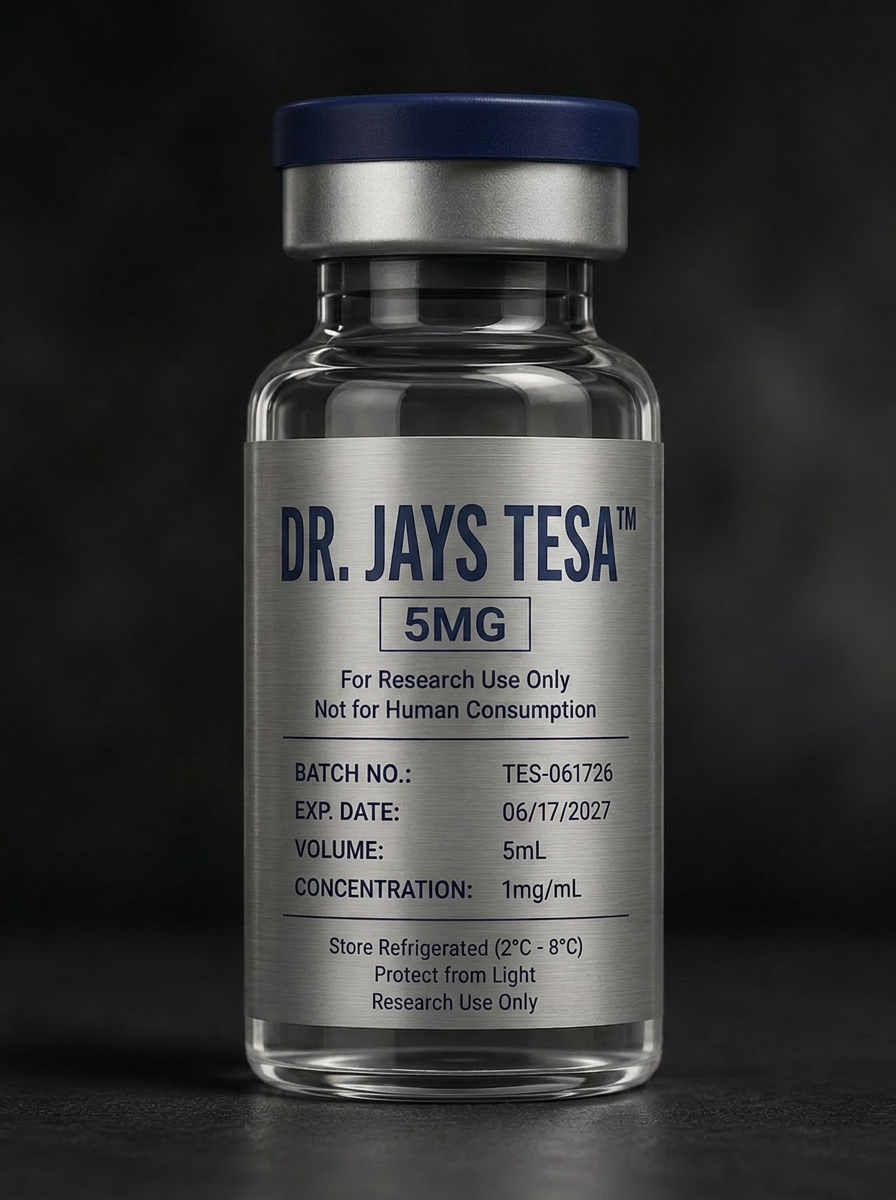
What Is Dr. Jays TESA™ – Research Grade GHRH Analog Peptide (Tesamorelin)?
Tesamorelin is a synthetic 44-amino-acid peptide built on the complete GHRH(1-44) sequence with a single specific modification: a trans-3-hexenoic acid group attached to the N-terminal tyrosine. The peptide sequence corresponds exactly to the natural human GHRH(1-44) — the full-length form of the hypothalamic releasing hormone secreted by GHRH-producing neurons in the arcuate nucleus and other hypothalamic regions. The C-terminal amidation that is present in the natural full-length GHRH is retained in tesamorelin, and the rest of the sequence is unmodified from the natural human GHRH(1-44).
The defining structural innovation is the trans-3-hexenoic acid N-terminal modification. The natural GHRH(1-44) has a free N-terminal alpha-amine on the tyrosine residue at position 1, and this N-terminal is the primary site of proteolytic cleavage by dipeptidyl peptidase-4 (DPP-4), which removes the N-terminal Tyr-Ala dipeptide and produces an inactive GHRH(3-44) fragment. This DPP-4 cleavage is the principal pathway by which natural GHRH is rapidly inactivated in plasma — the half-life of unmodified GHRH in plasma is on the order of minutes, limiting its practical use as a research or clinical tool. The trans-3-hexenoic acid modification attached to the N-terminal amine blocks DPP-4 access to the cleavage site and substantially extends the plasma half-life.
The receptor-engagement profile of tesamorelin is that of a full GHRH receptor agonist. The compound binds and activates the GHRH receptor (a class B G-protein-coupled receptor expressed prominently on pituitary somatotroph cells) with affinity and efficacy comparable to the natural GHRH, signaling through Gs-coupled adenylyl-cyclase activation and elevation of intracellular cyclic AMP. The downstream signaling cascade in pituitary somatotroph cells leads to stimulation of growth hormone synthesis and secretion through the canonical GHRH-receptor pathway. The retention of the full-length GHRH(1-44) sequence in tesamorelin means that the receptor-engagement profile is closer to that of the natural full-length hormone than to that of the shorter GHRH(1-29) analogs (sermorelin and CJC-1295 with and without DAC) that are also commonly used in GHRH-axis research.
It is worth being specific about what tesamorelin is not. It is not a growth-hormone-secretagogue-receptor (GHSR / ghrelin-receptor) agonist — it does not engage the GHSR receptor used by ghrelin, hexarelin, ipamorelin, and the other "GH secretagogue" research peptides. It is not growth hormone itself — it is the upstream releasing hormone that stimulates pituitary growth hormone secretion. And it is not a depot-style ultra-long-acting analog — its plasma half-life of approximately 30 minutes after subcutaneous administration is substantially extended relative to unmodified GHRH but is short compared to the multi-day half-lives of the lipidated long-acting peptides (semaglutide, cagrilintide, tirzepatide) that dominate the contemporary long-acting peptide landscape.
History and Development
Tesamorelin's development sits inside the broader history of GHRH research that emerged through the 1980s and the medicinal-chemistry effort to produce stabilized GHRH analogs that began in the same period.
The natural GHRH was isolated and characterized in the early 1980s through work by Roger Guillemin and his collaborators (Guillemin had previously shared the 1977 Nobel Prize in Physiology or Medicine for the original discovery of hypothalamic releasing hormones, particularly TRH). The GHRH-isolation work in the early 1980s characterized GHRH as a 44-amino-acid peptide hormone (in its full-length form, GHRH(1-44)) produced primarily in the arcuate nucleus and other hypothalamic regions and acting on pituitary somatotroph cells through a specific GHRH receptor to stimulate growth hormone synthesis and secretion. The shorter GHRH(1-29) fragment was also characterized as biologically active, with the N-terminal 29 residues constituting the minimal sequence required for receptor activation.
The DPP-4 cleavage of GHRH at the N-terminal Tyr-Ala dipeptide was characterized through the 1980s and 1990s as the primary pathway by which natural GHRH is rapidly inactivated in plasma. The recognition that N-terminal modifications could protect against DPP-4 cleavage motivated several lines of medicinal-chemistry effort to produce stabilized GHRH analogs. The principal strategies included: (1) modification of the alanine at position 2 to a residue that prevents DPP-4 recognition (the strategy used in sermorelin's CJC-1295 derivatives, where the alanine is replaced or the surrounding residues are modified); (2) attachment of a non-amino-acid group to the N-terminal alpha-amine to block DPP-4 access (the strategy used in tesamorelin); and (3) addition of an albumin-binding linker (the strategy used in CJC-1295 with DAC, which adds a maleimide-containing linker to the C-terminus of a stabilized GHRH(1-29) analog).
Theratechnologies, a Canadian pharmaceutical company based in Montreal, developed tesamorelin in the 2000s as a stabilized full-length GHRH(1-44) analog using the trans-3-hexenoic acid N-terminal modification strategy. The compound was characterized in extensive preclinical and clinical research and was approved by the U.S. FDA in 2010 under the brand name Egrifta for a specific clinical indication in adult HIV-infected patients with lipodystrophy. The approval represented the first GHRH analog to reach clinical use as an approved therapeutic, complementing the earlier use of sermorelin (which had been approved in the late 1990s for a different specific indication).
The broader GHRH-analog research field has continued to develop, with multiple stabilized GHRH(1-29) analogs (including the CJC-1295 with-DAC and without-DAC variants), the full-length GHRH(1-44) analog tesamorelin, and various other research-peptide derivatives. The GHRH-analog field complements and overlaps with the GH-secretagogue field (anchored by ipamorelin and the other GHSR-receptor agonists) in the broader pituitary growth-hormone-axis research landscape.
Important milestones include the early-1980s isolation of GHRH by Guillemin and collaborators, the 1980s-1990s characterization of DPP-4 cleavage as the primary GHRH inactivation pathway, the late-1990s sermorelin approval for a specific clinical indication, the 2000s development of tesamorelin at Theratechnologies, and the 2010 tesamorelin approval under the Egrifta brand.
Understanding the Science
The science of tesamorelin is anchored in three connected areas: the natural biology of GHRH as a hypothalamic releasing hormone, the GHRH receptor and pituitary somatotroph biology that mediate GHRH's effects, and the medicinal chemistry of the trans-3-hexenoic acid N-terminal modification that confers tesamorelin's stability advantage.
GHRH biology
Growth-hormone-releasing hormone (GHRH) is a hypothalamic peptide produced primarily in the arcuate nucleus and secreted into the hypophyseal portal circulation. GHRH acts on pituitary somatotroph cells through the GHRH receptor to stimulate growth hormone synthesis and secretion. The natural GHRH exists primarily in two forms — the full-length GHRH(1-44) and a slightly shorter GHRH(1-40) — produced from the GHRH precursor protein by tissue-specific processing. The receptor-active N-terminal portion of GHRH is the first 29 residues (GHRH(1-29) is biologically active), with the additional residues providing structural and stability contributions. GHRH secretion is pulsatile, with episodes of secretion producing pulsatile growth hormone release from the somatotrophs; the somatostatin counter-regulatory hormone suppresses growth hormone secretion and contributes to the pulsatile pattern.
GHRH receptor pharmacology
The GHRH receptor is a class B G-protein-coupled receptor expressed prominently on pituitary somatotroph cells. The receptor binds GHRH and synthetic GHRH analogs (including tesamorelin, sermorelin, and the CJC-1295 derivatives) and signals through Gs-coupled adenylyl-cyclase activation and elevation of intracellular cyclic AMP. The downstream signaling cascade involves protein kinase A activation, phosphorylation of cAMP-response-element-binding protein (CREB), and stimulation of growth hormone gene transcription, growth hormone synthesis, and growth hormone secretion. The pituitary somatotrophs are the principal target cells, although GHRH receptor expression has also been characterized in some other tissues with less well-understood physiological roles.
DPP-4 cleavage and N-terminal stabilization
Dipeptidyl peptidase-4 (DPP-4) is a serine protease that cleaves N-terminal dipeptides from peptide substrates with specific N-terminal sequences. GHRH has the N-terminal Tyr-Ala dipeptide that is a substrate for DPP-4, and the cleavage produces the N-terminally truncated GHRH(3-44) fragment that is inactive at the GHRH receptor. The trans-3-hexenoic acid modification on tesamorelin attaches a non-amino-acid acyl group to the N-terminal alpha-amine of the tyrosine at position 1, blocking DPP-4 access to the cleavage site and preventing the production of the inactive GHRH(3-44) fragment. The N-terminal modification substantially extends the plasma half-life of the molecule and is the defining stability innovation of tesamorelin.
Full-length GHRH(1-44) versus GHRH(1-29) scaffolds
The choice of the full-length GHRH(1-44) scaffold for tesamorelin (rather than the shorter GHRH(1-29) scaffold used in sermorelin and the CJC-1295 derivatives) is a deliberate design decision. The C-terminal residues (30-44) of GHRH are not required for receptor activation but contribute to receptor-binding affinity and to the overall structural and stability characteristics of the molecule. Retaining the full-length sequence in tesamorelin produces a receptor-engagement profile closer to that of natural GHRH than the GHRH(1-29) analogs achieve, and contributes additional metabolic stability beyond that produced by the N-terminal hexenoic-acid modification alone.
Pituitary growth-hormone-axis pharmacology
Tesamorelin's pharmacology engages the pituitary growth-hormone axis through the GHRH-receptor pathway. The compound stimulates pulsatile growth hormone secretion from the somatotrophs in a pattern that approximates the natural pulsatile GHRH-driven growth hormone secretion. The downstream effects of stimulated growth hormone secretion propagate through the broader growth hormone axis, including IGF-1 production at hepatic and other tissue sites in response to circulating growth hormone, and the various direct and IGF-1-mediated effects of growth hormone on its many tissue targets. The integrated pharmacology of tesamorelin in research and clinical contexts is the integrated pharmacology of stimulated growth-hormone-axis activity through the upstream GHRH-receptor engagement.
- Tesamorelin is a stabilized 44-amino-acid GHRH(1-44) analog with a trans-3-hexenoic acid N-terminal modification that prevents DPP-4 cleavage.
- Retains the complete full-length GHRH(1-44) sequence, distinguishing it from the GHRH(1-29)-based sermorelin and CJC-1295 derivatives.
- Developed at Theratechnologies in the 2000s; approved by the U.S. FDA in 2010 under the brand name Egrifta for a specific clinical indication.
- Acts at the GHRH receptor (class B GPCR) on pituitary somatotroph cells to stimulate pulsatile growth hormone secretion through Gs / cAMP / PKA / CREB signaling.
- Distinct from GH-secretagogue research peptides (ipamorelin, hexarelin) that act at the GHSR / ghrelin receptor rather than at the GHRH receptor.
Structural Characteristics
Structurally, tesamorelin is a 44-amino-acid linear peptide built on the complete natural GHRH(1-44) sequence with a trans-3-hexenoic acid group attached to the N-terminal tyrosine. The molecular mass of tesamorelin is approximately 5196 daltons in the free-base form. The C-terminal amidation that is present in the natural full-length GHRH is retained in tesamorelin, with the C-terminal amide replacing what would otherwise be the free C-terminal carboxylic acid.
The trans-3-hexenoic acid N-terminal modification is the defining structural feature. The hexenoic-acid group is a six-carbon acyl chain with a trans double bond at the 3-position, attached to the N-terminal alpha-amine of the tyrosine at position 1 through an amide bond. The modification adds a small non-amino-acid acyl group to the N-terminus, blocking the DPP-4 cleavage site (which would otherwise cleave the N-terminal Tyr-Ala dipeptide) and substantially extending the plasma half-life of the molecule. The hexenoic-acid group is small relative to the long fatty-acid side chains used in lipidated long-acting peptides (such as semaglutide's C18 di-acid), and tesamorelin does not have albumin-binding lipidation pharmacology — the hexenoic-acid modification is a stability modification rather than a pharmacokinetic-extension modification.
The complete 44-amino-acid backbone provides the full GHRH receptor-binding surface and contributes additional structural stability beyond what the N-terminal 29 residues alone would provide. The peptide is a linear molecule without disulfide bridges or other cyclic constraints (GHRH does not have cysteines and therefore does not form disulfide-bridged loops in the way that, for example, somatostatin or oxytocin does).
The combined structural design — full-length GHRH(1-44) scaffold for complete receptor engagement, C-terminal amidation for matching the natural hormone chemistry, trans-3-hexenoic acid N-terminal modification for DPP-4-cleavage protection — produces a molecule with the receptor-engagement profile of natural GHRH and the metabolic stability needed for practical research and clinical use. The plasma half-life of tesamorelin after subcutaneous administration is on the order of 30 minutes — substantially longer than the few-minute half-life of unmodified GHRH but much shorter than the multi-day half-lives of the lipidated long-acting peptides.
Areas of Scientific Interest
Tesamorelin is studied in laboratory contexts that span GHRH receptor pharmacology, pituitary growth-hormone-axis research, comparative pharmacology of GHRH analogs and GH secretagogues, and broader metabolic-research areas connected to growth-hormone-axis signaling.
In GHRH receptor pharmacology, tesamorelin serves as a reference stabilized full-length GHRH analog for studies on receptor binding and signaling at the GHRH receptor, on the downstream Gs / cyclic AMP / PKA / CREB cascade activated by GHRH-receptor engagement, on the comparative pharmacology of full-length GHRH(1-44) analogs versus shorter GHRH(1-29) analogs, and on the structure-activity relationships within the broader GHRH-analog research lineage.
In pituitary growth-hormone-axis research, tesamorelin appears in studies on the pulsatile growth hormone secretion produced by GHRH-receptor stimulation, on the integration of GHRH-receptor signaling with the somatostatin counter-regulatory signaling that contributes to the pulsatile growth-hormone-secretion pattern, on the differences and similarities between GHRH-mediated growth hormone secretion and ghrelin-receptor-mediated growth hormone secretion (the GH-secretagogue pharmacology), and on the integrated pharmacology of the growth-hormone-axis at the pituitary, hepatic, and peripheral tissue levels.
In comparative GHRH-analog and GH-secretagogue research, tesamorelin is used as a reference compound alongside sermorelin (a shorter GHRH(1-29) analog with simpler chemistry), the CJC-1295 derivatives (GHRH(1-29) analogs with stabilizing modifications including the albumin-binding DAC linker variant), and the GH-secretagogue research peptides ipamorelin and hexarelin (which act at the GHSR / ghrelin receptor rather than at the GHRH receptor). The comparative pharmacology characterizes the differences between GHRH-receptor engagement and GHSR-receptor engagement in producing growth hormone secretion, and the differences between full-length GHRH(1-44) and GHRH(1-29) scaffolds.
In broader metabolic-research areas, tesamorelin appears in studies on the integration of growth-hormone-axis signaling with metabolic regulation, particularly on the effects of stimulated growth hormone secretion on body composition, on lipid metabolism, and on related metabolic endpoints. The clinical-research literature on tesamorelin in the Egrifta approval context addresses specific metabolic-research questions that are part of this broader integration of growth-hormone-axis and metabolic pharmacology.
Across all of these contexts, the research applications in the research-peptide supply context are laboratory and analytical in nature. The compound's status as an approved pharmaceutical under the Egrifta brand for a specific clinical indication is a separate channel; research-peptide use is intended for laboratory and analytical work distinct from clinical use of the approved product.
Comparison With Related Compounds
Tesamorelin sits within the broader landscape of GHRH-analog and growth-hormone-axis research peptides, with related but distinguishable comparators across the GHRH-analog, GH-secretagogue, and natural-hormone categories.
| Compound | Classification | Distinguishing feature |
|---|---|---|
| Natural GHRH(1-44) | Full-length natural hypothalamic releasing hormone | Parent natural sequence; identical to tesamorelin except for the N-terminal hexenoic-acid modification; rapidly degraded by DPP-4 with a few-minute plasma half-life, limiting practical use. |
| Sermorelin (GHRH(1-29)) | Shorter GHRH analog with the receptor-active N-terminal 29 residues | Shorter scaffold (29 vs. 44 residues); no N-terminal stabilization modification; comparable receptor-engagement profile but shorter plasma half-life; approved in the late 1990s for a specific clinical indication. |
| CJC-1295 (with DAC) | Stabilized GHRH(1-29) analog with albumin-binding maleimide linker | Different stability strategy — albumin-binding DAC linker for very long plasma half-life (multi-day range); produces sustained GHRH-receptor engagement rather than pulsatile engagement. |
| CJC-1295 (no DAC) / Mod GRF(1-29) | Stabilized GHRH(1-29) analog with N-terminal modifications | GHRH(1-29) scaffold with amino-acid substitutions that protect against DPP-4 cleavage; intermediate plasma half-life between sermorelin and tesamorelin; no albumin-binding component. |
| Ipamorelin | Selective ghrelin-receptor (GHSR) agonist | Different receptor target — GHSR (ghrelin receptor) rather than GHRH receptor; complementary pharmacology to GHRH analogs; often paired with GHRH analogs in growth-hormone-axis research. |
Frequently Asked Questions
Q.What is tesamorelin?
Tesamorelin is a synthetic stabilized analog of the natural hypothalamic peptide growth-hormone-releasing hormone (GHRH). It retains the complete 44-amino-acid GHRH(1-44) sequence and adds a trans-3-hexenoic acid group at the N-terminus that blocks DPP-4 cleavage and substantially extends the plasma half-life relative to unmodified GHRH. The compound was developed at Theratechnologies and was approved by the U.S. FDA in 2010 under the brand name Egrifta for a specific clinical indication.
Q.How does tesamorelin work?
Tesamorelin is a GHRH receptor agonist. It binds and activates the GHRH receptor (a class B G-protein-coupled receptor expressed prominently on pituitary somatotroph cells) and signals through Gs-coupled adenylyl-cyclase activation and elevation of intracellular cyclic AMP. The downstream signaling cascade in somatotrophs involves protein kinase A activation, phosphorylation of CREB, and stimulation of growth hormone synthesis and secretion. The result is stimulation of pulsatile growth hormone secretion from the pituitary, with downstream effects through the broader growth-hormone axis including hepatic IGF-1 production.
Q.How is tesamorelin different from sermorelin?
Two main differences. First, tesamorelin uses the complete 44-amino-acid GHRH(1-44) scaffold while sermorelin uses the shorter 29-amino-acid GHRH(1-29) scaffold; the longer scaffold in tesamorelin contributes additional receptor-binding-affinity and structural-stability contributions. Second, tesamorelin has the trans-3-hexenoic acid N-terminal modification that blocks DPP-4 cleavage and extends the plasma half-life, while sermorelin does not have an N-terminal stabilization modification and is more rapidly degraded.
Q.How is tesamorelin different from CJC-1295?
Different scaffold, different stability strategy. CJC-1295 (both with-DAC and without-DAC variants) uses the GHRH(1-29) scaffold with amino-acid substitutions that protect against DPP-4 cleavage. The with-DAC variant adds a maleimide-containing linker that produces albumin-binding pharmacokinetics with a multi-day plasma half-life. Tesamorelin uses the full-length GHRH(1-44) scaffold and the trans-3-hexenoic acid N-terminal modification, producing a plasma half-life on the order of 30 minutes — substantially longer than unmodified GHRH but much shorter than the with-DAC variant of CJC-1295.
Q.Is tesamorelin growth hormone?
No. Tesamorelin is GHRH — the upstream hypothalamic releasing hormone that stimulates pituitary growth hormone secretion. It acts on the GHRH receptor on pituitary somatotroph cells to stimulate the cells to synthesize and secrete growth hormone. The growth hormone itself is then released from the pituitary into circulation and produces the downstream effects of the growth-hormone axis. Tesamorelin and growth hormone are different molecules with different sources, different receptors, and different positions in the growth-hormone-axis signaling cascade.
Q.What is DPP-4 and why does it matter for GHRH?
DPP-4 (dipeptidyl peptidase-4) is a serine protease that cleaves N-terminal dipeptides from peptide substrates with specific N-terminal sequences. GHRH has the N-terminal Tyr-Ala dipeptide that is a substrate for DPP-4, and the cleavage produces the N-terminally truncated GHRH(3-44) fragment that is inactive at the GHRH receptor. DPP-4 cleavage is the principal pathway by which natural GHRH is rapidly inactivated in plasma, with a half-life on the order of minutes. The trans-3-hexenoic acid modification on tesamorelin blocks DPP-4 access to the cleavage site and substantially extends the plasma half-life.
Q.What does the trans-3-hexenoic acid modification do?
The trans-3-hexenoic acid group is a small six-carbon acyl chain attached to the N-terminal alpha-amine of the tyrosine at position 1 of tesamorelin. The modification blocks DPP-4 access to the N-terminal Tyr-Ala cleavage site, preventing the rapid DPP-4-mediated inactivation that limits the half-life of unmodified GHRH. The result is a substantial extension of the plasma half-life — from a few minutes for unmodified GHRH to approximately 30 minutes for tesamorelin. The hexenoic-acid modification is a stability modification rather than an albumin-binding lipidation modification.
Q.Who developed tesamorelin?
Tesamorelin was developed at Theratechnologies, a Canadian pharmaceutical company based in Montreal, through its GHRH-analog research program in the 2000s. The compound was approved by the U.S. FDA in 2010 under the brand name Egrifta for a specific clinical indication in adult HIV-infected patients with lipodystrophy. The approval represented the first GHRH analog to reach clinical use as an approved therapeutic for a specific metabolic indication.
Q.Is tesamorelin a GH secretagogue?
Tesamorelin stimulates growth hormone secretion, but it is distinct from the compounds typically referred to as 'GH secretagogues' in the research-peptide literature. The 'GH secretagogue' label is generally used for compounds that act at the GHSR (growth-hormone-secretagogue receptor, also called the ghrelin receptor) — including ipamorelin, hexarelin, GHRP-2, GHRP-6, and others. Tesamorelin acts at the GHRH receptor, not at the GHSR. Both receptor systems can produce growth hormone secretion, but the receptors, signaling cascades, and integrated pharmacology profiles are different.
Q.What is the molecular weight of tesamorelin?
Tesamorelin has a molecular mass of approximately 5196 daltons in the free-base form. The 44-amino-acid GHRH(1-44) backbone contributes the bulk of the mass, with the C-terminal amidation and the trans-3-hexenoic acid N-terminal modification contributing the additional chemistry. The exact mass for a particular batch is reported on the Certificate of Analysis from a reputable research-peptide supplier and confirmed by mass spectrometry.
Q.How is tesamorelin administered in research contexts?
In published research and clinical literature, tesamorelin is administered by subcutaneous injection. The peptide structure is not orally bioavailable in any practical way — like most peptides, the molecule would be degraded in the gastrointestinal tract before significant absorption. The plasma half-life of approximately 30 minutes supports once-daily dosing in research and clinical contexts. The research-peptide supply context contemplates laboratory and analytical work rather than personal administration.
Q.What storage and reconstitution practices apply?
Lyophilized tesamorelin stored sealed at -20 °C or below away from light is generally considered stable for extended periods. The N-terminal hexenoic-acid modification and the full-length scaffold give the compound reasonable chemical stability for a 44-amino-acid peptide. After reconstitution in sterile water or bacteriostatic water, the compound is typically stored refrigerated and used within several weeks. Standard research-laboratory storage and handling practices apply.
Q.How is tesamorelin manufactured?
Research-grade tesamorelin is produced by solid-phase peptide synthesis using Fmoc protecting-group chemistry, with the 44-amino-acid linear sequence assembled on an amide-bond-forming resin (which generates the C-terminal amide on cleavage). The trans-3-hexenoic acid N-terminal modification is performed at the end of the synthesis by reaction of the N-terminal alpha-amine with trans-3-hexenoic acid or an activated derivative. The crude modified peptide is purified by reversed-phase HPLC and characterized by mass spectrometry and other analytical methods.
Q.Is tesamorelin approved as a medicine?
Tesamorelin was approved by the U.S. FDA in 2010 under the brand name Egrifta for a specific clinical indication in adult HIV-infected patients with lipodystrophy. That regulatory approval is the channel through which the compound is used as an approved medicine in the United States. The research-peptide supply of tesamorelin for laboratory work is a separate channel from the approved-product channel; the research-peptide use is intended for laboratory work, not personal administration or clinical use.
Q.What is the half-life of tesamorelin?
The plasma half-life of tesamorelin after subcutaneous administration is approximately 30 minutes. This is substantially longer than the few-minute half-life of unmodified GHRH (due to the DPP-4-cleavage protection from the N-terminal hexenoic-acid modification) but much shorter than the multi-day half-lives of the lipidated long-acting peptides such as semaglutide or cagrilintide. The half-life profile supports once-daily dosing and produces pulsatile growth-hormone-stimulation pharmacology rather than sustained continuous stimulation.
Q.How does tesamorelin compare to growth hormone replacement?
Different mechanism. Growth hormone replacement involves direct administration of growth hormone, which then acts on growth hormone receptors throughout the body. Tesamorelin acts upstream — it stimulates the pituitary somatotrophs to secrete the body's own growth hormone through the GHRH-receptor pathway. The integrated pharmacology of GHRH-receptor stimulation produces pulsatile growth hormone secretion that approximates the natural pulsatile pattern, distinct from the more continuous pattern produced by direct growth hormone administration. The differences are important in research and clinical contexts on the relative effects of pulsatile versus continuous growth-hormone-axis stimulation.
Q.Is tesamorelin safe?
Comprehensive safety characterization of tesamorelin was conducted as part of the regulatory-approval process for the Egrifta product, and the approved-product label includes the documented safety profile for that indication and use context. The research-peptide supply of the compound for laboratory work is a separate channel; the comprehensive safety characterization is applicable to clinical use of the approved product rather than to laboratory research-peptide use. Educational discussion of safety should remain within the laboratory-research and approved-product framings appropriate to the actual use channels rather than extrapolating to off-label or personal-use contexts.
Glossary of Terms
- Tesamorelin
- Synthetic stabilized 44-amino-acid GHRH(1-44) analog with a trans-3-hexenoic acid N-terminal modification; developed at Theratechnologies and approved by the U.S. FDA in 2010 under the brand name Egrifta.
- GHRH
- Growth-hormone-releasing hormone; natural hypothalamic 44-amino-acid peptide that stimulates growth hormone secretion from pituitary somatotrophs.
- GHRH receptor
- Class B G-protein-coupled receptor expressed prominently on pituitary somatotroph cells; the receptor engaged by tesamorelin and other GHRH analogs.
- Somatotroph
- Pituitary cell type that produces and secretes growth hormone; the principal target cell of GHRH and GHRH-analog pharmacology.
- DPP-4
- Dipeptidyl peptidase-4; serine protease that cleaves N-terminal dipeptides from GHRH and many other peptide substrates; the principal pathway by which natural GHRH is inactivated in plasma.
- Trans-3-hexenoic acid
- Six-carbon acyl group attached to the N-terminal alpha-amine of tesamorelin's tyrosine residue; blocks DPP-4 cleavage and extends the plasma half-life.
- GHRH(1-44)
- Full-length form of natural GHRH; the scaffold used in tesamorelin, distinguished from the shorter GHRH(1-29) scaffold used in sermorelin and the CJC-1295 derivatives.
- GHRH(1-29)
- Receptor-active N-terminal 29-residue fragment of GHRH; the minimal sequence required for receptor activation and the scaffold used in sermorelin and the CJC-1295 derivatives.
- Pulsatile secretion
- Episodic pattern of growth hormone release driven by pulsatile GHRH stimulation and somatostatin counter-regulation; the natural pattern that tesamorelin pharmacology approximates.
- Egrifta
- Brand name under which tesamorelin is approved by the U.S. FDA for a specific clinical indication in adult HIV-infected patients with lipodystrophy.
Summary
Tesamorelin is a synthetic stabilized analog of the natural hypothalamic peptide growth-hormone-releasing hormone (GHRH), built on the complete 44-amino-acid GHRH(1-44) scaffold with a trans-3-hexenoic acid N-terminal modification that blocks DPP-4 cleavage and substantially extends the plasma half-life relative to unmodified GHRH. The compound was developed at Theratechnologies (a Canadian pharmaceutical company) in the 2000s and was approved by the U.S. FDA in 2010 under the brand name Egrifta for a specific clinical indication in adult HIV-infected patients with lipodystrophy.
The receptor-engagement profile is that of a full GHRH receptor agonist. The compound binds and activates the GHRH receptor (a class B G-protein-coupled receptor) on pituitary somatotroph cells with affinity and efficacy comparable to natural GHRH, signaling through Gs-coupled adenylyl-cyclase activation and elevation of intracellular cyclic AMP, with downstream effects on growth hormone gene transcription, synthesis, and pulsatile secretion. The retention of the full-length GHRH(1-44) sequence distinguishes tesamorelin from the shorter GHRH(1-29) analogs (sermorelin and the CJC-1295 with-and-without-DAC variants) that are also commonly used in GHRH-axis research.
The DPP-4-cleavage-protection from the N-terminal hexenoic-acid modification produces a plasma half-life of approximately 30 minutes — substantially longer than the few-minute half-life of unmodified GHRH but much shorter than the multi-day half-lives of the contemporary lipidated long-acting peptides. The half-life profile supports once-daily dosing and produces pulsatile growth-hormone-stimulation pharmacology that approximates the natural pulsatile pattern, distinct from the more sustained engagement produced by the albumin-binding-linker CJC-1295 with-DAC variant.
Tesamorelin's published research footprint spans GHRH receptor pharmacology, pituitary growth-hormone-axis research, comparative pharmacology of GHRH analogs and GH secretagogues, and broader metabolic-research areas connected to growth-hormone-axis signaling. The compound appears in many research contexts as a reference stabilized full-length GHRH analog with a well-defined receptor-engagement profile and a well-characterized stability advantage relative to unmodified GHRH.
For students, researchers, and curious readers approaching tesamorelin for the first time, the most accurate framing is of a thoughtfully engineered stabilized full-length GHRH(1-44) analog with a defined N-terminal modification strategy, an approved-product status for a specific clinical indication, and a well-established position in the broader pituitary growth-hormone-axis research landscape — distinguished from the GHRH(1-29)-based analogs by the full-length scaffold choice, distinguished from the GH-secretagogue research peptides by the GHRH-receptor (rather than GHSR / ghrelin-receptor) target, and distinguished from direct growth-hormone administration by the upstream pituitary-stimulation rather than direct-receptor-engagement mechanism.
Scientific References
Selected peer-reviewed and primary-source citations used to inform this educational overview. Inclusion does not imply endorsement of any non-research use of Dr. Jays TESA™ – Research Grade GHRH Analog Peptide (Tesamorelin).
- Falutz, J., et al. (2007). Metabolic effects of a growth hormone-releasing factor in patients with HIV. New England Journal of Medicine, 357(23), 2359-2370.Foundational clinical-research characterization of tesamorelin in the specific clinical context that led to the 2010 Egrifta approval.
- Guillemin, R., et al. (1982). Growth hormone-releasing factor from a human pancreatic tumor that caused acromegaly. Science, 218(4572), 585-587.Foundational isolation and characterization of GHRH as a hypothalamic releasing hormone.
- Frohman, L. A., et al. (1986). Rapid enzymatic degradation of growth hormone-releasing hormone by plasma in vitro and in vivo to a biologically inactive product cleaved at the N-terminus. Journal of Clinical Investigation, 78(4), 906-913.Characterization of DPP-4-mediated N-terminal cleavage as the principal GHRH inactivation pathway; provides mechanistic background for the tesamorelin N-terminal stabilization strategy.
- Stanley, T., & Grinspoon, S. (2015). Effects of growth hormone-releasing hormone on visceral fat, metabolic, and cardiovascular indices in human studies. Growth Hormone & IGF Research, 25(2), 59-65.Review of GHRH and GHRH-analog pharmacology in metabolic-research contexts relevant to the tesamorelin research and approval program.